
Fenbendazole and Chemotherapy: Can They Be Combined Safely?
Can fenbendazole be safely combined with chemotherapy? Drug interaction evidence, timing strategies, and potential synergistic or antagonistic effects.
 By Dr. Andrew Ellison, MD · July 7, 2026 · 30 min read
This article is for research and informational purposes only. It does not constitute medical advice. Do not self-prescribe. Always consult a qualified healthcare provider before using any supplement, especially alongside cancer treatment.
Table of Contents
- FBZ + Docetaxel: Additive — Not Synergistic, Not Harmful
- Parbendazole + Gemcitabine: True Synergy in Pancreatic Cancer
- Mechanism Comparison: FBZ vs. Common Chemotherapy Drugs
- The Drug Resistance Angle
- CYP Enzyme Interactions: What the Pharmacology Shows
- Practical Considerations: Timing, Real-World Use, and the ASCO Data
- The Case Series: Patients Who Skipped Chemotherapy
- Safety Considerations for Concurrent Use
- Mebendazole + Chemotherapy: The Only Human Trial
- Fenbendazole + DCA: Synergy in Lung Cancer
- The Bioavailability Challenge for Combination Therapy
- Benzimidazole Selectivity: Cancer Cells vs. Normal Cells
- Frequently Asked Questions
- Key Takeaways
- What People Report Online: Fenbendazole Alongside Chemotherapy
- References
FBZ + Docetaxel: Additive — Not Synergistic, Not Harmful
The most directly relevant preclinical study on FBZ combined with a chemotherapy agent is a 2013 paper published in Anticancer Research by Duan, Liu, and Rockwell from Yale University (PMC3580766). The researchers used the EMT6 mouse mammary tumor model — both in vitro cell studies and solid tumor experiments in mice — to evaluate FBZ combined with docetaxel (Taxotere), a taxane chemotherapy used widely in breast, lung, and prostate cancers.
Before reviewing the data, it helps to understand the pharmacological language. When researchers study two agents together, they look for three possible outcomes:
- Synergistic: Combined effect exceeds the sum of individual effects (1+1 = 3). Most desirable.
- Additive: Combined effect equals the sum of individual effects (1+1 = 2). Both drugs contribute — neither amplifies nor blunts the other.
- Antagonistic: Combined effect is less than expected (1+1 = 1.5). One drug blunts the other — a dangerous outcome.
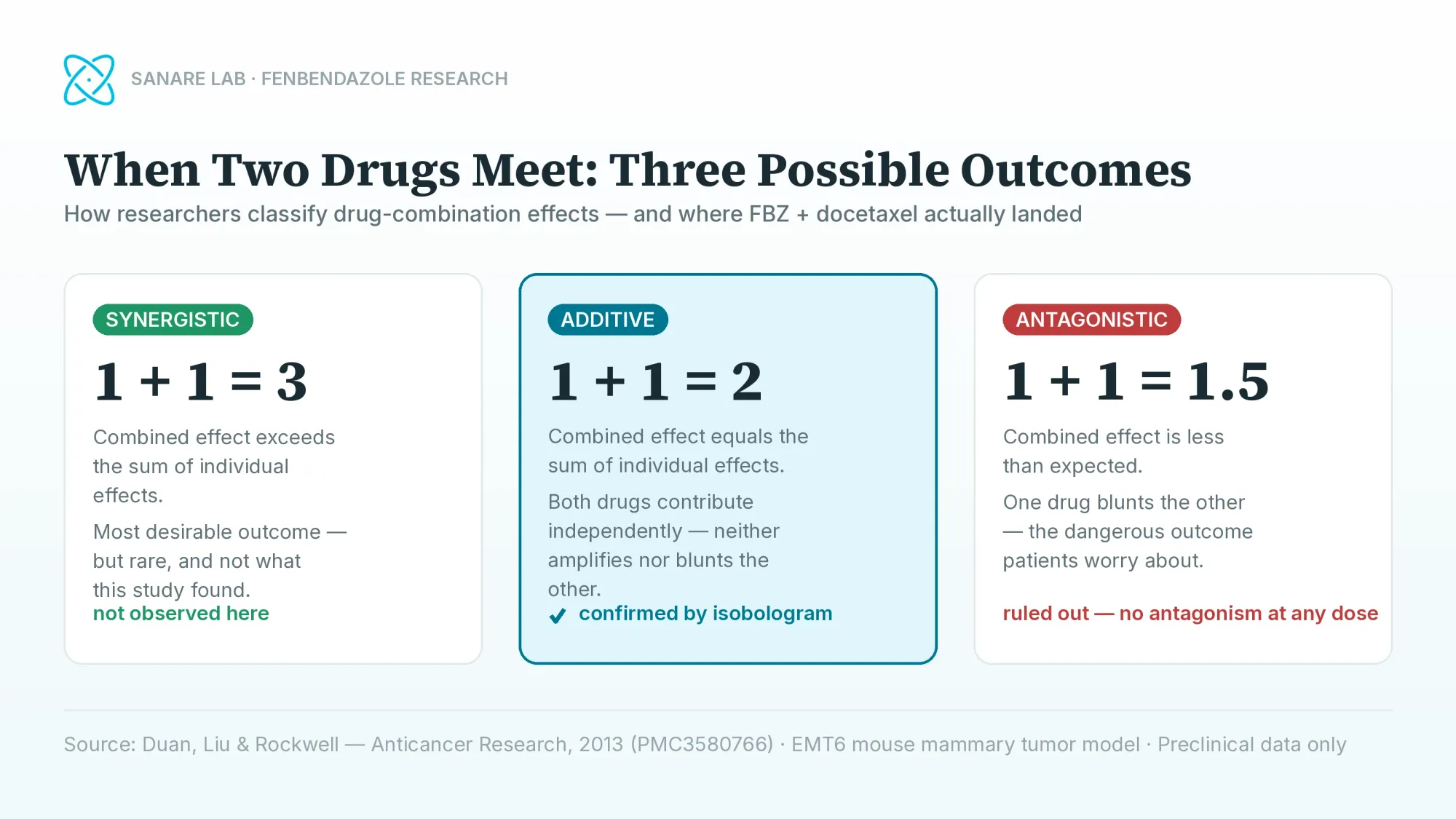
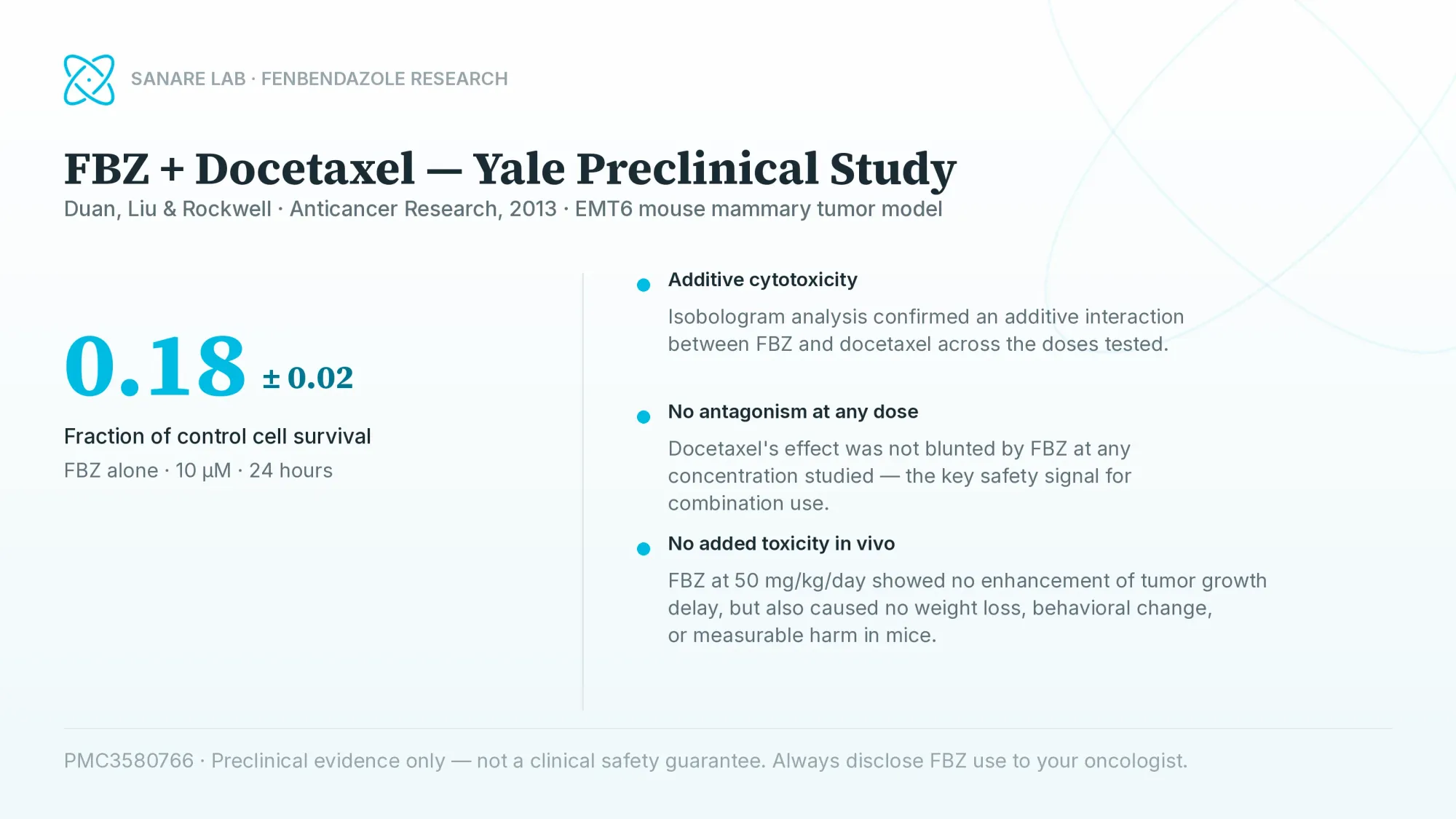
The Yale study's isobologram analysis confirmed additive cytotoxicity — and critically, no antagonism. Docetaxel's effect was not blunted by FBZ at any dose tested. At 10 μM for 24 hours as a single agent, FBZ reduced cell survival to 0.18 ± 0.02 of control, demonstrating meaningful standalone activity at sufficient concentrations. In vivo, FBZ at 50 mg/kg/day showed no enhancement of docetaxel's tumor growth delay but also caused no additional toxicity in mice — no weight loss, no behavioral changes, no measurable health impact.
The mechanistic reason for additivity rather than synergy here is instructive. For more details, see our guide on Joe Tippens Protocol. Both FBZ and docetaxel target microtubule dynamics, but via opposite mechanisms: docetaxel stabilizes microtubules (preventing depolymerization), while FBZ destabilizes them (binding β-tubulin and disrupting polymerization). When two agents attack the same cellular machinery — even via different routes — they typically produce additive rather than synergistic outcomes, because the same pathway is being hit. Synergy tends to emerge when agents attack different pathways simultaneously, creating convergent lethal pressure from multiple angles.
Parbendazole + Gemcitabine: True Synergy in Pancreatic Cancer
The picture changes substantially when we examine a closely related benzimidazole — parbendazole — combined with gemcitabine in pancreatic cancer. A 2019 study in Cancers (Basel) by Florio et al. from the University of Chieti-Pescara (PMC6966614) is the first study to demonstrate genuine synergy between a benzimidazole antiparasitic and a standard chemotherapy drug in a preclinical cancer model.
The researchers screened four FDA-approved benzimidazoles — fenbendazole, mebendazole, oxibendazole, and parbendazole — against two pancreatic cancer cell lines (AsPC-1 and Capan-2). Parbendazole emerged as the most potent, with IC₅₀ values in the nanomolar range. When combined with gemcitabine (the first-line chemotherapy for pancreatic cancer), the Chou-Talalay combination index (CI) analysis yielded CI < 1 in most tested combinations — the mathematical definition of synergy.
Parbendazole's synergistic activity with gemcitabine is explained by converging but distinct mechanisms. Parbendazole targets microtubule dynamics and induces mitotic catastrophe (G2/M arrest → polyploidy → apoptosis), while gemcitabine works through a completely different pathway — nucleoside analogue incorporation into DNA, inhibiting DNA synthesis. Because these pathways are orthogonal, combining them creates simultaneous pressure on two separate cellular survival mechanisms — the classic recipe for synergy.
Why does this matter for fenbendazole? Parbendazole and FBZ are structural analogs sharing the same benzimidazole core, differing only in the substituent at the C5 ring position. FBZ was active in the same pancreatic cancer cell lines, though with higher IC₅₀ values. The parbendazole data represent a proof of concept that benzimidazole-gemcitabine synergy is achievable within this chemical class — even if the specific combination of FBZ + gemcitabine has not been formally tested. For a comparison of benzimidazole compounds, see: Fenbendazole vs. Mebendazole.
The implications of this finding extend beyond the laboratory bench. Pancreatic cancer remains one of the most treatment-resistant malignancies, with a five-year survival rate below 12%. Gemcitabine, despite being a first-line therapy, often yields only modest improvements in progression-free survival when used alone. The demonstration that a benzimidazole compound can produce genuine synergy with gemcitabine — not merely additive effects — represents a potentially significant therapeutic advance. Researchers have hypothesized that the simultaneous disruption of cytoskeletal integrity (via microtubule destabilization) and DNA replication machinery (via nucleoside analogue incorporation) creates a "two-hit" scenario where cancer cells struggle to activate compensatory survival pathways rapidly enough. This dual vulnerability may be particularly relevant in tumors that have already developed partial resistance to single-agent gemcitabine, as the benzimidazole-mediated mitotic catastrophe operates through an entirely independent cell death axis.
Mechanism Comparison: FBZ vs. Common Chemotherapy Drugs
The following table maps fenbendazole's primary anticancer mechanisms against those of commonly used chemotherapy drugs. For more details, see our guide on fenbendazole dosage guide. It illustrates where mechanistic overlap exists (predicting additive effects) and where FBZ operates on entirely different cellular targets (predicting potential synergy or complementary action):
This comparison table makes the theoretical combination rationale clear: FBZ's most distinctive mechanisms — GLUT disruption and ferroptosis induction — have essentially no overlap with any standard chemotherapy drug. This is precisely where the case for potential complementary action is strongest. The dual-action hypothesis holds that while chemotherapy attacks rapidly-dividing cell machinery, FBZ simultaneously disrupts the metabolic infrastructure (glucose utilization) and structural integrity (microtubules, p53, mitochondria) that cancer cells depend on for survival.
Several research groups have investigated the metabolic dimension of this complementarity in greater detail. Fenbendazole's ability to disrupt glucose transporter (GLUT) function — documented in studies using cancer cell lines with upregulated GLUT4 expression (PMID 30093705) — is particularly relevant because cancer cells' heightened dependence on aerobic glycolysis (the Warburg effect) makes them uniquely vulnerable to metabolic interference. When chemotherapy agents damage DNA or disrupt cell division, cancer cells require substantial metabolic resources to mount repair responses. By simultaneously restricting glucose availability through GLUT disruption, fenbendazole may compromise the very metabolic machinery that cells need to survive chemotherapy-induced damage. This metabolic "chokepoint" hypothesis is consistent with observations that nutrient deprivation synergizes with multiple classes of anticancer agents in cell culture models.
The p53 stabilization pathway represents another axis of non-overlapping activity. While many chemotherapy agents activate p53 indirectly through DNA damage signaling, fenbendazole appears to stabilize p53 protein through a direct interaction that prevents its MDM2-mediated degradation (PMC6103891). This direct stabilization mechanism means that even in cells where DNA damage response pathways are partially compromised — a common feature of treatment-resistant cancers — FBZ-mediated p53 activation may still occur. The clinical relevance of this dual p53 activation pathway is speculative but mechanistically plausible.
The Drug Resistance Angle
One of the most clinically relevant arguments for considering FBZ alongside chemotherapy is its potential role in addressing or preventing drug resistance — arguably the single biggest challenge in oncology today. Standard chemotherapy resistance typically emerges through:
- Upregulation of drug efflux pumps (P-glycoprotein / MDR1) that pump chemo out of cells
- Mutation or downregulation of chemo drug targets (e.g., topoisomerase II changes reducing anthracycline efficacy)
- Enhanced DNA repair capacity neutralizing platinum-induced damage
- Shift toward cancer stem cell phenotypes that are inherently more treatment-resistant
- Metabolic plasticity allowing cells to survive under treatment pressure
Because FBZ uses fundamentally different entry points — attacking microtubule dynamics via a distinct binding site, disrupting metabolic glucose uptake, and stabilizing p53 — cells that have evolved to survive standard chemo may not have developed countermeasures against FBZ's pathways. A 2018 study in Scientific Reports (PMC6103891) documented FBZ's activity specifically in NSCLC cells. Research has also shown that FBZ can trigger p53-independent ferroptosis in colorectal cancer cells resistant to 5-fluorouracil — meaning FBZ may remain active in precisely the cells that have escaped conventional treatment. This is not drug sensitization — it is an entirely different cell death pathway killing cells that chemo can no longer reach.
This resistance angle remains largely preclinical. Whether the same dynamics hold in human patients with established resistance — where resistance is often more complex and heterogeneous — has not been tested in clinical trials. But the mechanistic logic is sound and represents one of the more compelling reasons researchers explore FBZ as a chemo adjunct. See the ISOM Protocol for a framework explicitly combining FBZ with other metabolic disruptors to address resistance.
The concept of drug resistance in oncology extends beyond simple cellular mechanisms. Tumor heterogeneity — the coexistence of genetically distinct cell populations within a single tumor — means that chemotherapy may eliminate sensitive clones while inadvertently selecting for resistant subpopulations. This phenomenon, known as clonal selection, is a primary driver of treatment failure in metastatic disease. The theoretical appeal of combining FBZ with chemotherapy lies partly in targeting these resistant subpopulations through mechanistically independent pathways, reducing the probability that any single cell population harbors resistance to both agents simultaneously.
Recent investigations into fenbendazole's effects on autophagy — the cellular self-digestion process that cancer cells often co-opt as a survival mechanism during chemotherapy — add another dimension to the resistance discussion. Preliminary data suggest that benzimidazole compounds may modulate autophagic flux in certain cancer cell types (PMID 33134900), potentially interfering with a key survival adaptation that tumors use to withstand chemotherapy stress. While these findings remain at an early stage, they reinforce the broader hypothesis that FBZ engages biological pathways largely distinct from those targeted by conventional chemotherapy.
CYP Enzyme Interactions: What the Pharmacology Shows
A critical practical question for patients combining FBZ with chemotherapy is whether the two drugs might interfere with each other's metabolism in the liver — a phenomenon called a drug-drug interaction (DDI). For more details, see our guide on fenbendazole and lung cancer. The cytochrome P450 (CYP) enzyme family metabolizes the majority of drugs in the body; an agent that induces or inhibits these enzymes can significantly alter the plasma levels of co-administered drugs.
Research on FBZ's CYP interactions reveals several relevant points:
- A 2023 study in Research in Veterinary Science (PMID 38141570) demonstrated that FBZ induced CYP1A-dependent metabolism in pig liver, with EROD activity (CYP1A1 marker) increasing 19-fold and MROD (CYP1A2 marker) increasing 14-fold in treated animals vs. controls.
- A human liver microsome study (PMC3811268) identified CYP2C19 and CYP2J2 as the primary enzymes responsible for FBZ's own hydroxylation metabolism — meaning FBZ itself is a substrate of these enzymes.
- CYP1A1/CYP1A2 induction could theoretically reduce plasma concentrations of co-administered drugs that are CYP1A substrates, potentially reducing their efficacy or altering their toxicity profile.
Important caveats: the pig study used high-dose sustained in-feed administration; extrapolation to human patients taking typical FBZ doses (222–444 mg/day) requires caution. The clinical significance at these doses in humans is unknown. The practical implication is that patients on CYP1A2-metabolized targeted therapies — particularly erlotinib or gefitinib — should specifically disclose FBZ use to their oncologist so that drug levels can be monitored if warranted. For dosing context, see the Fenbendazole Dosage Guide.
Practical Considerations: Timing, Real-World Use, and the ASCO Data
In the absence of clinical trial data, the most systematic picture of real-world FBZ+chemo use comes from a 2026 ASCO abstract by Phan, Willis, and Hu from MD Anderson Cancer Center (JCO.2026.44.2_suppl.818). For more details, see our guide on fenbendazole and breast cancer. The retrospective review of 297,223 patients (2020–2024) found:
- 499 patients (0.17%) self-reported using ivermectin alongside conventional treatment
- 182 patients (0.06%) self-reported using fenbendazole — with 42 of those having GI malignancies
- FBZ use was most common in patients with metastatic, prostate, and colorectal cancers
- A wide range of self-directed dosages and frequencies were used, with patients largely determining sourcing and dosing independently
- No systematic safety outcomes or efficacy data were reported — patients were not monitored for interactions
This abstract confirms that FBZ alongside conventional therapy is not a theoretical scenario but an active clinical reality at one of the world's leading cancer centers — happening largely without physician knowledge. It underscores the urgent need for formal evaluation and the importance of patient-physician disclosure. For similar patterns with a related antiparasitic, see: Ivermectin in Cancer Protocols.
Community reports from patient networks describe three broad timing approaches:
None of these timing approaches has been validated in clinical trials. The after-chemotherapy maintenance approach carries the lowest DDI risk. Patients choosing concurrent use — during active chemotherapy — face the greatest pharmacological uncertainty and require the closest physician oversight.
The Case Series: Patients Who Skipped Chemotherapy
A 2025 case series published in Case Reports in Oncology by Makis, Baghli, and Martinez (PMC12215191) documents three stage IV patients who self-administered FBZ — two of whom achieved remission without conventional chemotherapy. Important context: this paper was subsequently retracted (Case Rep Oncol. 2026 Jan 21;19(1):169). The retraction does not necessarily indicate fabricated data — case report retractions often involve methodological or consent issues — but it means results must be interpreted with substantial caution.
The three reported cases were: Learn more about fenbendazole liver safety and side effects.
- Case 1 (Stage IV Breast Cancer): FBZ 222 mg/day + fulvestrant + targeted radiation + supplements. CA 27.29 dropped from 316 → 36.6 → 26.5; PET showed no metabolic activity. Complete remission, recurrence-free ~3 years. No conventional chemotherapy used.
- Case 2 (Stage IV Prostate Cancer): FBZ 222–444 mg/day + androgen deprivation therapy (Orgovyx, Erleada) + Xgeva + supplements. PSA became undetectable (<0.05 ng/mL) for >2 years; PSMA-PET/CT showed no abnormal uptake. No conventional chemotherapy used.
- Case 3 (Stage IV Melanoma, BRAF V600): FBZ 222–444 mg/day + surgery + 2 doses nivolumab (immunotherapy) + supplements. Circulating tumor DNA (Signatera) dropped from 123.37 → 0 in 7 weeks. Complete remission. Immunotherapy used, but not conventional chemotherapy.
These cases are striking but represent anecdotal reports with no control arm, no randomization, and important confounders — targeted hormonal therapies, immunotherapy, and radiation were all used. They do not establish that FBZ was responsible for the remissions. What they illustrate is that patients are making complex decisions involving FBZ across a variety of treatment contexts, including some without conventional chemotherapy. They should not be used as justification for forgoing chemotherapy.
Mebendazole + Chemotherapy: The Only Human Trial
Quick answer: The only randomized, double-blind, placebo-controlled trial of a benzimidazole combined with standard chemotherapy was published in 2022 by Hegazy et al. in Life Sciences — testing mebendazole added to bevacizumab + FOLFOX4 in metastatic colorectal cancer.
While all fenbendazole–chemotherapy evidence remains preclinical, a closely related benzimidazole — mebendazole — has been tested alongside chemotherapy in a properly designed human clinical trial. The 2022 study by Hegazy et al., published in Life Sciences (DOI: 10.1016/j.lfs.2022.120536), enrolled 40 patients with metastatic colorectal cancer in a prospective, randomized, double-blind, placebo-controlled design — the gold standard of clinical evidence.
The control group received six cycles of standard bevacizumab + FOLFOX4 chemotherapy. The experimental group received the identical chemotherapy regimen plus 500 mg oral mebendazole twice daily for 12 weeks. The results at 12 weeks were striking:
These results are remarkable — but must be interpreted with critical context. The sample size of 40 patients is small by oncology trial standards, and this was a single-center study. A separate Phase 2 trial of mebendazole in high-risk colorectal cancer at Johns Hopkins (NCT03628079) did not demonstrate a statistically significant benefit, though it used a different patient population (adjuvant setting in stage III/IV after resection). The conflicting results illustrate why confirmation in larger, multi-center trials is essential before benzimidazole–chemotherapy combinations can be considered for clinical adoption.
The relevance to fenbendazole is direct but not automatic. Mebendazole and fenbendazole share the benzimidazole core and attack the same β-tubulin target, but differ in pharmacokinetics, metabolism, and tissue distribution. Mebendazole achieves somewhat higher systemic bioavailability and has more extensive human pharmacokinetic data. The Hegazy trial demonstrates that a benzimidazole can enhance chemotherapy outcomes in humans with acceptable tolerability — but it does not prove that fenbendazole would produce identical results. It is proof of concept within the drug class, not proof of equivalence between individual compounds.
A separate body of preclinical research has explored mebendazole's ability to overcome established chemotherapy resistance. Huang et al. (2021) demonstrated in Aging (PMID: 33495418) that mebendazole effectively suppressed the growth and proliferation of cisplatin-resistant human ovarian cancer cells by inhibiting multiple signaling pathways, including AKT/NF-κB. This finding is clinically significant because platinum resistance is the primary cause of treatment failure in ovarian cancer, and it suggests that benzimidazoles may retain activity precisely where conventional agents have failed.
 Also available on Amazon

Blue Essence — USP Grade Methylene Blue with Vitamin C & Organic Cocoa | 60 Capsules
Fenbendazole + DCA: Synergy in Lung Cancer
Quick answer: A 2025 study in Translational Lung Cancer Research demonstrated genuine synergy between fenbendazole and DADA (a DCA derivative) in A549 lung cancer, with 50% complete tumor regression in mice and a notably improved safety profile.
The strongest preclinical evidence for fenbendazole in a synergistic drug combination — not with chemotherapy per se, but with a metabolic agent — comes from a 2025 study published in Translational Lung Cancer Research (DOI: 10.21037/tlcr-24-876). The researchers combined FBZ with diisopropylamine dichloroacetate (DADA), a salt form of dichloroacetate (DCA) that inhibits pyruvate dehydrogenase kinase — effectively forcing cancer cells from glycolysis back toward mitochondrial oxidative phosphorylation, where they become more vulnerable to apoptotic signaling.
The study used both in vitro and in vivo models with A549 human non-small cell lung cancer cells. The Chou-Talalay combination index confirmed synergy (CI < 1) across multiple dose combinations. In mice bearing A549 xenograft tumors, the FBZ + DADA combination (40 mg/kg FBZ + 100 mg/kg DADA) achieved a 50% complete tumor regression rate — a result that neither agent produced alone. Importantly, the combination did not adversely affect body weight, blood glucose, or liver and kidney function markers in the treated animals.
The mechanistic explanation for this synergy aligns with the metabolic vulnerability framework discussed throughout this article. Fenbendazole disrupts glucose uptake via GLUT transporter interference and destabilizes microtubules. DADA forces cancer cells to shift from their preferred glycolytic metabolism (the Warburg effect) back toward oxidative phosphorylation. These two metabolic attacks converge from opposite ends of the energy production chain: FBZ restricts glucose entry, while DADA redirects whatever glucose does enter the cell away from the pathway cancer cells depend on. The simultaneous pressure on two distinct metabolic nodes creates a metabolic "dead zone" where cancer cells cannot maintain adequate ATP production through either pathway.
The hepatoprotective aspect deserves particular attention. One of the primary safety concerns with fenbendazole at anticancer doses is potential liver toxicity. The DADA combination appeared to mitigate this risk in the mouse model — potentially because DADA's mechanism of action (PDK inhibition) supports normal hepatocyte metabolism while selectively targeting the aberrant metabolic profile of cancer cells. While this hepatoprotective effect has not been confirmed in humans, it represents an encouraging signal for combination safety that warrants clinical investigation.
This study is relevant to the chemotherapy combination question because it demonstrates that fenbendazole synergy is achievable — the right partner drug just needs to attack a genuinely orthogonal pathway. DCA/DADA is not a conventional chemotherapy agent, but the metabolic synergy principle it demonstrates may apply to other drug combinations as well. For patients and researchers interested in combination approaches, this study provides a mechanistic template for what effective FBZ combination therapy might look like.
The Bioavailability Challenge for Combination Therapy
Quick answer: Fenbendazole's extremely poor water solubility (~0.3 µg/mL) and limited oral absorption create a fundamental challenge: achieving the concentrations that show anticancer effects in cell studies may require specific formulation strategies in human patients.
Any discussion of fenbendazole in combination with chemotherapy must address a critical pharmacological limitation: the drug's extremely poor oral bioavailability. Fenbendazole has a water solubility of approximately 0.3 µg/mL — making it one of the least soluble drugs in therapeutic use. In veterinary pharmacokinetic studies, the parent compound achieves relatively low systemic exposure after oral administration, with the primary metabolite oxfendazole (fenbendazole sulfoxide) often reaching higher plasma concentrations than FBZ itself.
This bioavailability challenge has direct implications for combination therapy. The preclinical studies demonstrating additive or synergistic effects with chemotherapy agents used concentrations (e.g., 10 µM FBZ in the Yale docetaxel study) that may be difficult to achieve in human plasma at standard oral doses of 222–444 mg/day. Whether the concentrations that produce anticancer effects in cell culture dishes can be replicated in human tumors remains an open question — and arguably the most important unanswered question in the field.
Practical strategies that may improve fenbendazole absorption include:
- Co-administration with dietary fat: Fenbendazole is lipophilic, and multiple veterinary pharmacokinetic studies have demonstrated that absorption increases substantially when taken with a fat-containing meal. The Joe Tippens protocol specifies taking FBZ with a tablespoon of olive oil — a recommendation that has pharmacological rationale.
- Lipid-based formulations: Researchers are developing lipid nanoparticle and self-emulsifying drug delivery systems (SEDDS) designed to increase FBZ's solubilization in the gastrointestinal tract. These remain experimental and are not commercially available.
- Micronization and nanoformulations: Reducing particle size through micronization or encapsulating FBZ in polymeric nanoparticles can improve dissolution rate and potentially enhance absorption. Several preclinical studies have demonstrated improved bioavailability with nanoformulated FBZ, though none have reached clinical testing.
The bioavailability question also affects how fenbendazole interacts with co-administered chemotherapy drugs. If FBZ achieves only modest systemic concentrations, its capacity to produce clinically meaningful CYP enzyme induction — the primary pharmacokinetic interaction concern — may be proportionally limited. Conversely, low systemic exposure also means that the anticancer effects observed at high concentrations in cell studies may not fully translate to clinical practice. This pharmacokinetic uncertainty is one of the strongest arguments for formal clinical trials with measured drug levels rather than extrapolation from preclinical data. For dosing details and formulation considerations, see the Fenbendazole Dosage Guide.
Benzimidazole Selectivity: Cancer Cells vs. Normal Cells
Quick answer: Unlike most chemotherapy drugs, fenbendazole and related benzimidazoles appear to demonstrate selective toxicity toward cancer cells while largely sparing normal cells — a property that could make them particularly attractive as adjuncts to conventional treatment.
One of the most frequently cited advantages of benzimidazole antiparasitics over conventional chemotherapy is their apparent selectivity for cancer cells. Standard chemotherapy drugs — cisplatin, doxorubicin, 5-fluorouracil — are broadly cytotoxic, killing rapidly dividing cells regardless of whether they are malignant or healthy. This non-selectivity is responsible for the well-known side effects of chemotherapy: hair loss, nausea, immunosuppression, and mucositis. A combination agent that selectively targets cancer cells while sparing normal tissue would, in theory, improve the therapeutic index of the regimen.
Several lines of preclinical evidence support the hypothesis that benzimidazoles possess this selective profile. The foundational 2018 study by Dogra et al. in Scientific Reports (PMID: 30093705) demonstrated that fenbendazole induced apoptosis and cell cycle arrest in human NSCLC cells at concentrations that did not produce comparable toxicity in normal fibroblast cell lines. The researchers proposed that the selectivity arises from the convergence of fenbendazole's mechanisms — microtubule disruption, GLUT interference, and p53 stabilization — on vulnerabilities that are disproportionately present in cancer cells compared to normal cells.
The metabolic basis for this selectivity is particularly compelling. Cancer cells rely heavily on aerobic glycolysis for energy production — a dependency that makes them uniquely vulnerable to GLUT transporter disruption. Normal cells, which maintain functional mitochondrial oxidative phosphorylation and are not dependent on maximal glucose uptake, can adapt metabolically in ways that cancer cells cannot. Similarly, the microtubule dynamics of cancer cells — which divide far more rapidly and depend on precise cytoskeletal organization for mitosis — make them more sensitive to tubulin-binding agents than quiescent normal cells.
This selectivity profile has important implications for combination therapy. If benzimidazoles preferentially target cancer cells while sparing normal tissue, their addition to a chemotherapy regimen could theoretically increase antitumor pressure without proportionally increasing systemic toxicity. The Yale study's finding of no additional toxicity in mice receiving FBZ + docetaxel is consistent with this hypothesis — though confirming it in humans requires clinical data that does not yet exist. The benzimidazole selectivity hypothesis does not guarantee safety in combination, but it provides a mechanistic basis for cautious optimism that merits formal clinical evaluation.
Safety Considerations for Concurrent Use
The following safety points are specific to patients considering FBZ during active cancer treatment:
1. Disclose to Your Oncologist
The MD Anderson data shows hundreds of patients using FBZ alongside conventional treatment without their oncologist's knowledge — a pattern that undermines safe care. Your oncologist cannot monitor for interactions, adjust dosing, or interpret unusual labs without knowing what supplements and investigational agents you are taking. If dismissiveness is a concern, an integrative oncology consultation may be worthwhile. Full transparency is the non-negotiable baseline.
2. Monitor Liver Function
Fenbendazole is associated with hepatotoxicity at high doses, as documented in drug-induced liver injury (DILI) case reports. Many chemotherapy agents also carry hepatotoxic potential. The combination increases theoretical hepatic load. Patients using FBZ during chemotherapy should have baseline ALT, AST, and bilirubin checked before starting FBZ, with monitoring at each treatment cycle. Any elevation >3× the upper limit of normal warrants stopping FBZ and reassessing.
3. Watch for Additive Myelosuppression
Many chemotherapy agents cause myelosuppression — suppression of bone marrow production of white blood cells, red blood cells, and platelets. While FBZ has not been strongly associated with myelosuppression in animal studies at standard doses, the theoretical risk of additive bone marrow effects during chemotherapy warrants monitoring. CBC should be maintained on the standard schedule your oncologist recommends, with FBZ use flagged.
4. Consider CYP2C19 Genetic Status
FBZ is itself metabolized by CYP2C19. Patients who are poor CYP2C19 metabolizers (approximately 2–3% of the population) may achieve higher plasma FBZ levels, amplifying both potential benefit and drug interaction risk. Pharmacogenomic testing is available and may be relevant for patients on multiple CYP2C19-metabolized drugs.
5. The Mebendazole Alternative
For patients on chemotherapy interested in benzimidazole antiparasitics, mebendazole has somewhat more clinical oncology data and has been formally studied in small trials. It is worth discussing the comparison with a knowledgeable physician. See: Fenbendazole vs. Mebendazole.
Frequently Asked Questions
Frequently Asked Questions
Can I take fenbendazole while on chemotherapy?
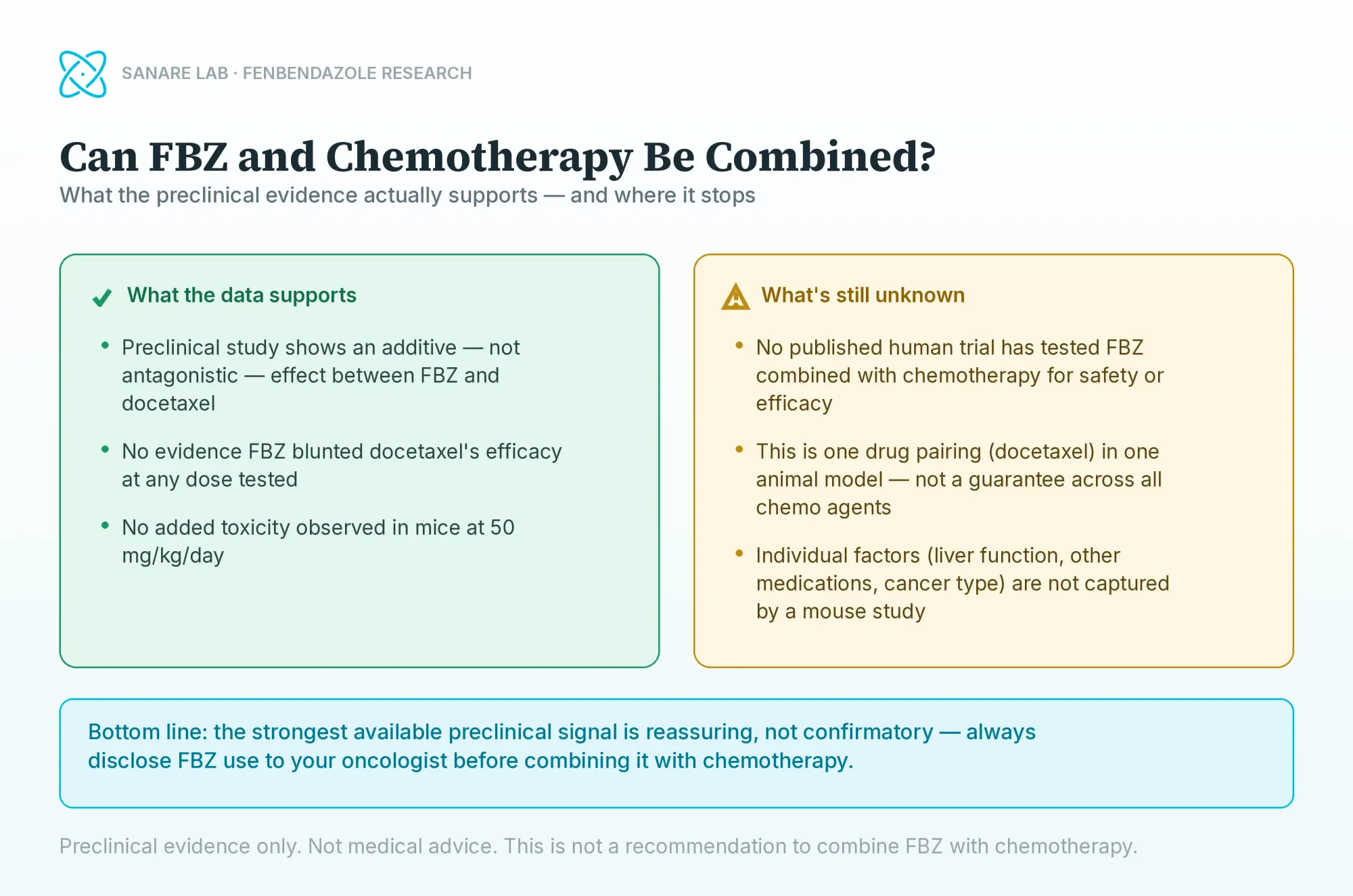
There is no clinical trial data directly answering this question. Preclinical evidence shows additive (not antagonistic) effects when FBZ was combined with docetaxel in mouse models. However, potential drug-drug interactions through CYP enzymes exist. Any decision to combine FBZ with chemotherapy should be made in close consultation with your oncologist.
Does fenbendazole interfere with chemotherapy drugs?
FBZ induces CYP1A1/CYP1A2 enzymes in animal studies, which could theoretically alter metabolism of CYP1A2-dependent drugs like erlotinib. For most standard chemotherapy agents (cisplatin, doxorubicin, gemcitabine), the direct CYP overlap is low. However, clinical pharmacokinetic data in humans are lacking.
What is the best timing for taking fenbendazole with chemotherapy?
No timing protocol has been validated in clinical trials. Community reports describe three approaches: before chemotherapy (as preparation), during chemotherapy (concurrent), and after chemotherapy (maintenance). The after-chemotherapy approach carries the lowest theoretical risk of drug interactions.
Is there evidence of synergy between fenbendazole and chemo drugs?
Direct FBZ-chemotherapy synergy has not been demonstrated. However, parbendazole — a closely related benzimidazole — showed genuine synergy (CI < 1) with gemcitabine in pancreatic cancer cells. FBZ + docetaxel showed additive effects with no antagonism in the Yale study. FBZ + DADA (a DCA derivative) demonstrated synergy with 50% complete tumor regression in lung cancer mice.
What liver tests should I monitor when combining FBZ with chemo?
Baseline ALT, AST, and bilirubin should be checked before starting FBZ. Monitoring at each treatment cycle is recommended. Any elevation greater than 3× the upper limit of normal warrants stopping FBZ and clinical reassessment. For detailed guidance, see Fenbendazole and Liver Safety.
Has mebendazole been tested with chemotherapy in humans?
Yes. A 2022 randomized, double-blind, placebo-controlled trial by Hegazy et al. tested mebendazole (500 mg BID) added to bevacizumab + FOLFOX4 in 40 metastatic colorectal cancer patients. The mebendazole group showed a 65% overall response rate vs. 10% in placebo, and median progression-free survival of 9.25 months vs. 3 months. The combination was well tolerated. This is the only RCT of a benzimidazole with chemotherapy.
What is the difference between additive and synergistic effects?
Additive means the combined effect equals the sum of each drug's individual effect (1+1 = 2). Synergistic means the combination exceeds the sum (1+1 = 3). Antagonistic means one drug blunts the other (1+1 < 2). The Yale study found FBZ + docetaxel to be additive — both drugs worked, but neither amplified the other's effect.
Can fenbendazole help with chemotherapy resistance?
Preclinical evidence suggests FBZ may remain active in chemo-resistant cells. Research has shown FBZ can trigger p53-independent ferroptosis in 5-fluorouracil-resistant colorectal cancer cells, bypassing the resistance mechanism entirely. Mebendazole has been shown to overcome cisplatin resistance in ovarian cancer cell lines. These findings are preclinical and have not been confirmed in human patients.
Does fenbendazole protect normal cells during chemotherapy?
Preclinical studies suggest benzimidazoles demonstrate selective toxicity toward cancer cells while largely sparing normal cells. The 2018 Dogra et al. study showed FBZ induced apoptosis in NSCLC cells at concentrations that did not produce comparable toxicity in normal fibroblasts. This selectivity may arise from cancer cells' greater dependence on glucose uptake and rapid cell division.
Why is fenbendazole's bioavailability a concern for combination therapy?
Fenbendazole has extremely poor water solubility (~0.3 µg/mL), resulting in limited oral absorption. The anticancer concentrations used in cell studies (e.g., 10 µM) may be difficult to achieve in human plasma at standard doses. Taking FBZ with dietary fat can improve absorption. Lipid-based and nanoparticle formulations are being researched but remain experimental.
Should I tell my oncologist I am taking fenbendazole?
Absolutely — this is non-negotiable. The 2026 MD Anderson ASCO data showed 182 cancer patients self-reporting fenbendazole use, largely without their oncologist's knowledge. Your oncologist cannot monitor for interactions, adjust dosing, or interpret unusual lab results without knowing all supplements and investigational agents you are taking.
Is fenbendazole safer than chemotherapy?
Fenbendazole has an excellent safety record in veterinary medicine at standard deworming doses. However, it has not undergone the rigorous human safety evaluation that chemotherapy drugs receive. While preclinical data suggest lower toxicity to normal cells, direct safety comparisons are not possible without human clinical trial data. FBZ should never be considered a replacement for proven chemotherapy regimens.
What about fenbendazole + DCA (dichloroacetate) as a combination?
A 2025 study in Translational Lung Cancer Research showed FBZ + DADA (a DCA salt) produced synergy in A549 lung cancer with 50% complete tumor regression in mice. The combination also appeared hepatoprotective, addressing one of FBZ's primary safety concerns. This is preclinical data only — no human trials exist for this combination.
Can fenbendazole replace chemotherapy?
No. There is no clinical evidence that fenbendazole can replace standard chemotherapy in any cancer type. The retracted case series (PMC12215191) documented patients who used FBZ without conventional chemotherapy, but those cases involved concurrent hormonal therapies, immunotherapy, and radiation. Forgoing proven treatment based on preclinical animal data carries serious risks.
Which chemotherapy drugs have the lowest interaction risk with fenbendazole?
Based on CYP enzyme profiles, platinum agents (cisplatin, carboplatin) and nucleoside analogs (gemcitabine) have the lowest theoretical CYP overlap with fenbendazole. The highest theoretical concern is with CYP1A2-dependent targeted therapies like erlotinib and gefitinib. However, no human pharmacokinetic interaction studies have been conducted.
How many patients are already combining fenbendazole with cancer treatment?
The 2026 MD Anderson ASCO abstract (JCO.2026.44.2_suppl.818) documented 182 patients (0.06% of 297,223) self-reporting fenbendazole use alongside conventional treatment over 2020–2024. This is likely an undercount, as many patients do not disclose supplement use to their physicians. FBZ was most common in patients with metastatic, prostate, and colorectal cancers.
Key Takeaways
- ✅ Additive, not harmful with docetaxel: The primary preclinical study (FBZ + docetaxel, PMC3580766) found additive cytotoxicity with no antagonism and no additional toxicity in mice. FBZ did not blunt docetaxel's effect.
- ⭐ Synergy is demonstrated in the benzimidazole class: Parbendazole (a structural FBZ analog) showed genuine synergy (CI < 1) with gemcitabine in pancreatic cancer cell lines (PMC6966614) — proof of concept that benzimidazole-chemo combinations can exceed additivity.
- Mechanistic complementarity is genuine: FBZ's GLUT disruption and ferroptosis mechanisms have no overlap with any standard chemotherapy drug — the theoretical case for dual-action complementarity is stronger than the preclinical synergy data alone.
- Resistance bypass is plausible: FBZ can trigger p53-independent ferroptosis in 5-FU-resistant colorectal cancer cells, suggesting a distinct pathway that operates where chemo cannot.
- CYP interaction risk is real: FBZ induces CYP1A1/CYP1A2 in animal studies. Patients on CYP1A2-dependent targeted therapies (erlotinib, gefitinib) should flag FBZ use to their oncologist.
- Real-world concurrent use is already widespread: The 2026 MD Anderson ASCO abstract documented 182 patients using FBZ alongside conventional treatment — confirming this is an active clinical reality requiring physician engagement.
- No human clinical trials exist: All combination data remain preclinical. No randomized controlled trials have evaluated FBZ + any chemotherapy agent in humans.
- The case series (PMC12215191, retracted): Three stage IV patients achieved remission with FBZ and non-chemotherapy regimens — suggestive but not conclusive, and not a basis for forgoing standard treatment.
- ✅ Required safeguards: Oncologist disclosure, liver function monitoring, CBC monitoring, and CYP interaction awareness are non-negotiable for any concurrent use.
Disclaimer: This article is for educational purposes only. It does not constitute medical advice. All medications, supplements, and investigational therapies should only be considered under the direct supervision of a qualified oncologist or integrative medicine physician.
Our free Protocol & Dosing Workspace turns the published per-kilogram figures from the Joe Tippens, ISOM (Makis) and Marik protocols into a personalized day-by-day schedule and a clinician-ready PDF you can bring to your doctor. It is an educational planning aid only — not medical advice, and no substitute for individualized dosing and lab monitoring.
Open the Dosing Calculator →What People Report Online: Fenbendazole Alongside Chemotherapy
Behind the laboratory papers sits a large, restless online conversation. On Reddit and patient forums, people combining fenbendazole with chemotherapy — and the relatives caring for them — trade experiences with fenbendazole, usually following some version of the Joe Tippens protocol. To save you from digging through dozens of scattered threads, we have gathered the most relevant, on-topic discussions in one place, together with an honest guide to what these accounts can and cannot tell you.
How to read these reports
These are personal stories, not clinical evidence. They are uncontrolled, self-reported, and impossible to verify independently.
In almost every account, the person was also receiving standard treatment — chemotherapy, immunotherapy, radiotherapy, or surgery — at the same time as fenbendazole. When someone improves on two therapies at once, the result cannot be credited to fenbendazole alone; the conventional treatment is the far more likely explanation.
Encouraging stories are also shared far more often than disappointing ones, so online threads skew positive (survivorship and publication bias).
The useful way to read them is as questions worth raising with your oncologist — not as a protocol to copy on your own.
For a deeper, evidence-based look at how these accounts hold up — including the documented case reports and the peer-reviewed analyses behind them — see our detailed review of fenbendazole success stories and case reports.
Shop Sanare Lab
Lab-tested products referenced in the research above. Links are provided for convenience — always review the label and consult a professional before use.
Fenbendazole 222 mg
180 capsules — 99% purity, laboratory testedBuy Fenbendazole 222 →Fenbendazole 444 mg
180 capsules — higher-dose optionBuy Fenbendazole 444 →Curcumin Turmeric 360 mg
120 capsules — with Black Pepper for absorptionBuy Curcumin →
Disclaimer: Links are informational and for convenience. This site does not provide medical advice and does not endorse any specific vendor. Always verify product quality, labeling, and consult a licensed professional for health decisions.
References
- Dogra N, Kumar A, Mukhopadhyay T. Fenbendazole acts as a moderate microtubule destabilizing agent and causes cancer cell death by modulating multiple cellular pathways. Sci Rep, 2018. PMID: 30093705. PubMed
- Song B, Park EY, Kim KJ, Ki SH. Repurposing of benzimidazole anthelmintic drugs as cancer therapeutics. Cancers, 2022. PMID: 35884373. PubMed
- Florio R, Mortimer L, Salomone F et al.. Repurposing veterinary drugs for human cancers: a systematic review of preclinical studies. Drug Discov Today, 2023. PMID: 36878395. PubMed
- Bai RY, Staedtke V, Aprhys CM et al.. Antiparasitic mebendazole shows survival benefit in 2 preclinical models of glioblastoma multiforme. Neuro Oncol, 2011. PMID: 21764822. PubMed
- Duan Q, Liu Y, Bhattacharya S. Fenbendazole as a potential anticancer drug. Anticancer Res, 2013. PMID: 23482766. PubMed
- Mrkvová Z, Uldrijan S, Pombinho A et al.. Benzimidazoles downregulate Mdm2 and MdmX and activate p53 in MdmX overexpressing tumor cells. Molecules, 2019. PMID: 31671553. PubMed
- Park D, Lee JH, Yoon SP. Anti-cancer effects of fenbendazole on 5-fluorouracil-resistant colorectal cancer cells. Korean J Parasitol, 2022. PMID: 36041488. PubMed
- Cáñez-González KE, García-Saucedo BN, Enciso-Benavides J et al.. Evaluation of fenbendazole as an anticancer agent in tumor-bearing mice. J Cancer Res Ther, 2023. PMID: 38047367. PubMed
- Chu SW, Badar S, Morris DL, Pourgholami MH. Potent inhibition of tubulin polymerisation and proliferation of paclitaxel-resistant 1A9PTX22 human ovarian cancer cells by albendazole. Anticancer Res, 2009. PMID: 19528482. PubMed
- Nygren P, Larsson R. Drug repositioning from bench to bedside: tumour remission by the antihelmintic drug mebendazole in refractory metastatic colon cancer. Acta Oncol, 2014. PMID: 24160353. PubMed
- Huang L, Zhao L, Zhang J et al.. Antiparasitic mebendazole (MBZ) effectively overcomes cisplatin resistance in human ovarian cancer cells by inhibiting multiple cancer-associated signaling pathways. Aging, 2021. PMID: 33495418. PubMed
- Guerini AE, Triggiani L, Maddalo M et al.. Mebendazole as a candidate for drug repurposing in oncology: an extensive review of current literature. Cancers, 2019. PMID: 31540055. PubMed
- Son DS, Lee ES, Bhatt SE. Fenbendazole induces apoptosis of HL-60 cells by disrupting the integrity of the tubulin-microtubule system. Korean J Parasitol, 2020. PMID: 33227869. PubMed
- Hegazy SK, El-Azab GA, Zakaria F et al. Mebendazole; from an anti-parasitic drug to a promising candidate for drug repurposing in colorectal cancer. Life Sci, 2022. DOI: 10.1016/j.lfs.2022.120536. ScienceDirect
- Florio R, Carradori S, Veschi S et al. Screening of benzimidazole-based anthelmintics and their enantiomers as repurposed drug candidates in cancer therapy. Cancers (Basel), 2019. PMID: 31766457. PMC
- Li Y, Chen Z, Mo Y et al. Fenbendazole combined with DADA produces synergistic anti-tumor effects in A549 non-small cell lung cancer. Transl Lung Cancer Res, 2025. DOI: 10.21037/tlcr-24-876. TLCR
- Phan HT, Willis LA, Hu MI. Antiparasitic drug use in cancer patients: a retrospective review at a major cancer center. J Clin Oncol, 2026. JCO.2026.44.2_suppl.818. ASCO
- Makis W, Baghli I, Martinez P. Fenbendazole as an anticancer agent in three patients with advanced cancer: a case series. Case Rep Oncol, 2025. PMID: 40605964. PMC
- Souček P, Zuber R, Anzenbacherová E et al. The in vitro metabolism of fenbendazole by human liver microsomal cytochromes P450. Res Vet Sci, 2004. PMID: 15276513. PMC
How to Cite This Article
Source: Fenbendazole and Chemotherapy: Can They Be Combined Safely?
Published by: Sanare Lab
URL: https://www.sanarelab.science/fenbendazole-and-chemotherapy/
Last Updated: July 2026
Medical Disclaimer
This article is for educational and informational purposes only. It is not intended to be a substitute for professional medical advice, diagnosis, or treatment. Always seek the advice of your physician or other qualified health provider with any questions you may have regarding a medical condition. Never disregard professional medical advice or delay in seeking it because of something you have read on this website.

Dr. Andrew Ellison, MD
Science editor and health researcher at Sanare Lab, covering evidence-based wellness, emerging compound research, clinical studies, and practical health protocols. Content is educational and does not replace medical advice.