Fenbendazole and ivermectin are two of the most discussed antiparasitic compounds in both veterinary medicine and emerging oncology research. While both have long histories as dewormers, they work through fundamentally different mechanisms, target different parasite types, and have distinct regulatory profiles.
This article provides a detailed, evidence-based comparison of fenbendazole and ivermectin — covering their mechanisms of action, approved uses, safety profiles, and the preclinical research that has attracted attention in the context of cancer and drug repurposing.
Quick Summary
- Ivermectin has approved human medical uses (onchocerciasis, strongyloidiasis, scabies) and is also used extensively in veterinary medicine. It acts fast by paralyzing parasites.
- Fenbendazole is primarily a veterinary antiparasitic (Panacur, Safe-Guard). It works by disrupting parasite cell structure and energy metabolism over several days.
- Both are being investigated in preclinical cancer research, but through different mechanisms.
- They are not interchangeable — the choice depends on parasite type, species, regulatory approval, and clinical context.
Side-by-Side Comparison

| Category | Fenbendazole | Ivermectin |
|---|---|---|
| Drug class | Benzimidazole | Avermectin (macrocyclic lactone) |
| Primary mechanism | β-tubulin binding → microtubule disruption | Glutamate-gated chloride channel binding → paralysis |
| Speed of action | Gradual (2–3 days) | Fast (hours to 1 day) |
| Veterinary use | Dogs, cats, horses, cattle, poultry | Dogs, cats, horses, cattle, sheep, pigs |
| Human approval | Not FDA-approved for humans | FDA-approved for specific parasitic infections |
| Parasite spectrum | Nematodes (roundworms, hookworms, whipworms), some cestodes, Giardia | Nematodes, ectoparasites (mites, lice), some filarial worms |
| Safety margin | Very wide (100x therapeutic dose tolerated in dogs) | Narrower; breed sensitivity in dogs (MDR1/ABCB1 mutation) |
| Administration | Oral (granules, capsules, suspension, paste) | Oral (tablets, paste) or injectable/topical |
| Nobel Prize | No | Yes (2015 — Physiology or Medicine) |
Mechanism of Action: How They Differ
Fenbendazole
Fenbendazole belongs to the benzimidazole class. It works by binding to β-tubulin in parasite cells, preventing the formation of microtubules — structural components essential for cell division, intracellular transport, and glucose uptake. Without functional microtubules, parasites cannot absorb nutrients and gradually starve over 2–3 days.
A 2018 study in Scientific Reports (Nature) confirmed that fenbendazole’s tubulin-binding mechanism also affects cancer cells in laboratory settings, disrupting microtubules, stabilizing the p53 tumor suppressor, and inhibiting glucose uptake (PMC6103891).
For a detailed overview of fenbendazole’s veterinary applications, see: Fenbendazole’s Uses in Veterinary Medicine.
Ivermectin
Ivermectin belongs to the avermectin class (macrocyclic lactones). It works by binding to glutamate-gated chloride channels in parasite nerve and muscle cells, causing an influx of chloride ions that leads to hyperpolarization, paralysis, and death. This mechanism acts rapidly — often within hours.
In mammals, these chloride channels are located behind the blood-brain barrier, which is why ivermectin is generally safe at approved doses. However, animals with MDR1 (ABCB1) gene mutations (common in Collies, Australian Shepherds, and related breeds) may have a compromised blood-brain barrier, making them sensitive to ivermectin toxicity.
For a comprehensive overview, see: Ivermectin: What It Is, How It Works, and Why It’s Used.
Approved Uses
Fenbendazole
- Veterinary: Approved worldwide for dogs, cats, horses, cattle, and poultry for treatment of roundworms, hookworms, whipworms, certain tapeworms, lungworms, and Giardia (off-label).
- Human: Not FDA-approved for human use. Its chemical cousin mebendazole is FDA-approved for human parasitic infections and shares the same mechanism of action.
Ivermectin
- Veterinary: Approved for dogs (heartworm prevention, mange), cattle (gastrointestinal nematodes, grubs), horses (strongyles, bots), sheep, and pigs.
- Human: FDA-approved for onchocerciasis (river blindness), strongyloidiasis, and scabies. Included on the WHO Model List of Essential Medicines. The developers received the 2015 Nobel Prize in Physiology or Medicine.
Safety Comparison
| Safety Factor | Fenbendazole | Ivermectin |
|---|---|---|
| Therapeutic index | Very high (100x margin in dogs) | Moderate (dose-dependent; narrower in some breeds) |
| Breed sensitivity | None known | MDR1/ABCB1 mutant breeds at risk |
| Common side effects | Mild GI upset, soft stool | Mild GI upset, dizziness (humans), Mazzotti reaction in filarial infections |
| Pregnancy safety | Generally considered safe in animals | Use with caution; contraindicated in early pregnancy (some protocols) |
| Drug interactions | Minimal documented interactions | CYP3A4 substrates; caution with P-glycoprotein inhibitors |
A review in Pharmacological Research compared the safety profiles of both compounds and noted fenbendazole’s broader safety margin in most mammalian species (PMC7505114).
Both Available from Sanare Lab
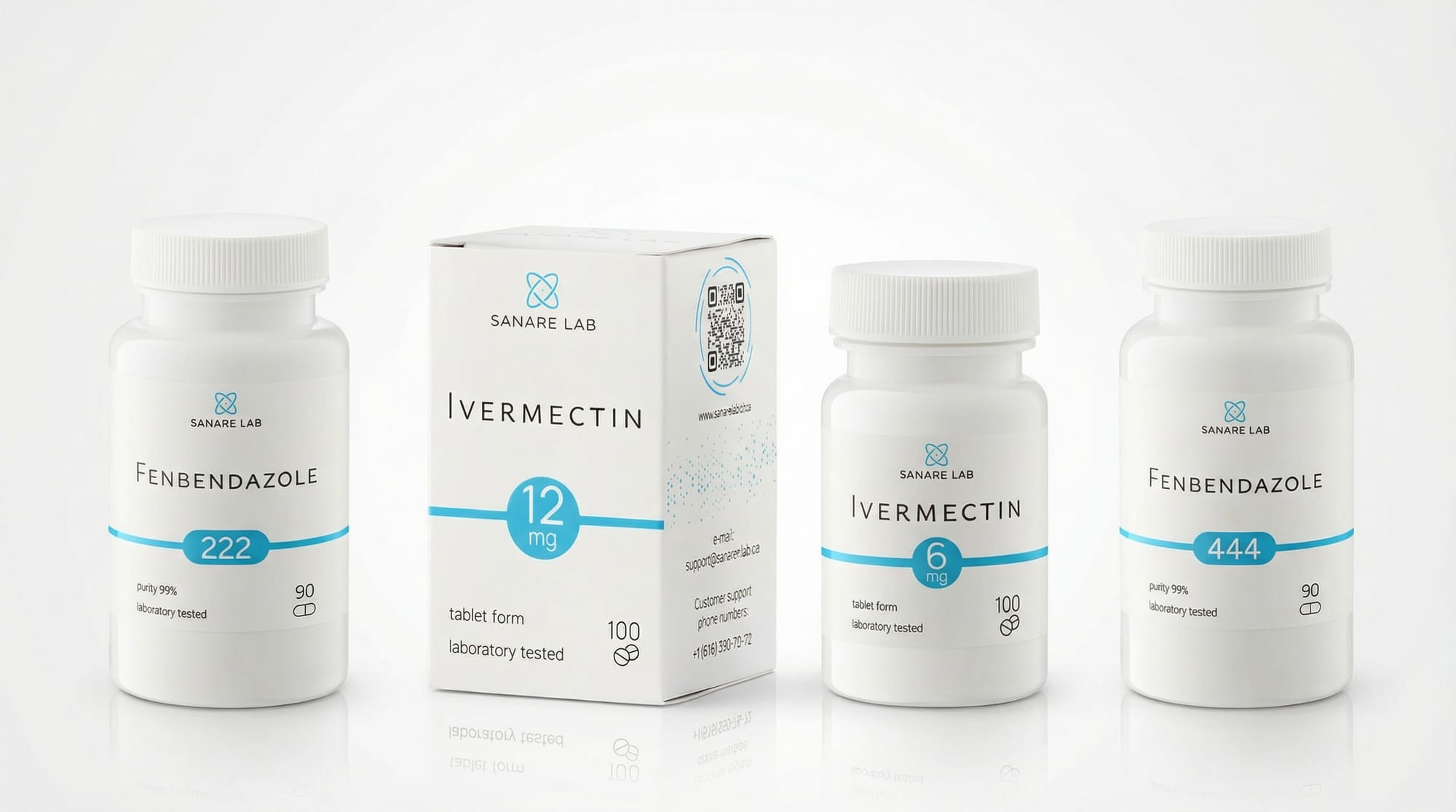
Pharmaceutical-grade fenbendazole and ivermectin — lab-tested with full documentation.
180 capsules — 99% purity, laboratory tested
180 capsules — higher dose option
6 / 12 / 18 mg — 100 tablets
Disclaimer: For convenience only. Consult a licensed professional.
Preclinical Cancer Research
Both fenbendazole and ivermectin have attracted significant attention in preclinical oncology research. While neither is approved for cancer treatment, the mechanisms they target are relevant to tumor biology:
| Research Area | Fenbendazole | Ivermectin |
|---|---|---|
| Primary anticancer mechanism | Microtubule disruption, p53 stabilization, glucose uptake inhibition | PAK1/WNT-TCF pathway inhibition, immunogenic cell death |
| Cancer cell types studied | NSCLC, colorectal, glioblastoma | Breast, ovarian, leukemia, glioblastoma |
| Immune effects | Indirect (via tumor microenvironment) | Direct immunogenic cell death induction |
| Clinical trials | None completed for cancer | NCT05318469 (Phase I/II, TNBC) |
| Public protocols | Joe Tippens Protocol | ISOM Protocol (both included) |
The key distinction: fenbendazole primarily targets structural and metabolic vulnerabilities in cancer cells, while ivermectin primarily targets signaling pathways and immune recognition. This is why some protocols, including the ISOM Protocol, combine both compounds as part of a multi-target metabolic strategy.
Which One to Choose?
For veterinary parasite treatment:
- Use fenbendazole for intestinal worms (roundworms, hookworms, whipworms) in dogs, cats, and livestock. See: Fenbendazole for Dogs.
- Use ivermectin for heartworm prevention, mange, and ectoparasites. Avoid in MDR1-mutant breeds without testing.
For human parasitic infections:
- Ivermectin is the FDA-approved option for specific infections (onchocerciasis, strongyloidiasis, scabies). Always under physician guidance.
- Fenbendazole is not approved for human use. For the same mechanism, mebendazole is the FDA-approved human equivalent.
In the context of drug repurposing research: Both are being investigated, but through different mechanisms. For dosing considerations, see: Fenbendazole Safety-Focused Dosage Guide.
Disclaimer: This article is for educational and informational purposes only. It does not constitute medical or veterinary advice. Always consult a qualified professional before using any antiparasitic medication.
Scientific References
- Dogra N, Kumar A, Mukhopadhyay T. (2018). Fenbendazole acts as a moderate microtubule destabilizing agent and causes cancer cell death. Scientific Reports (Nature), 8, 11926. PMC6103891
- Tang M, et al. (2020). Ivermectin, a potential anticancer drug derived from an antiparasitic drug. Pharmacological Research, 163, 105207. PMC7505114
- Laing R, et al. (2017). Ivermectin — old drug, new tricks? Trends in Parasitology, 33(6), 463–472. PubMed 28285851
- Son DS, et al. (2020). The antitumor potentials of benzimidazole anthelmintics as repurposing drugs. Immune Network, 20(4), e29. PMC7458798
- ClinicalTrials.gov. NCT05318469: Ivermectin + Immunotherapy in Metastatic TNBC. NCT05318469
Protocol Stack (Quick Links)
Both compounds discussed in this article are available below. Links are provided for convenience — always review the label and consult a professional before use.
180 capsules — 99% purity, laboratory tested
180 capsules — higher dose option
6 / 12 / 18 mg — 100 tablets
Disclaimer: Links are informational and for convenience. This site does not provide medical advice and does not endorse any specific vendor. Always verify product quality, labeling, and consult a licensed professional for health decisions.