
Happy Healing Store Is Spreading False Information
A forensic investigation into how Happy Healing Store fabricated 'Spectrix' fenbendazole purity reports to smear competitors while awarding itself an impossible 100%.
 By Dr. Andrew Ellison, MD · January 10, 2026 · 13 min read
This article is for research and informational purposes only. It does not constitute medical advice. Do not self-prescribe. Always consult a qualified healthcare provider before using any supplement, especially alongside cancer treatment.
Table of Contents
- The Setup: A "Study" That Was Really an Ad
- How We Know: The Real Report
- The Forgery, Detail by Embarrassing Detail
- They Didn't Only Come for Us — Fenben Lab Deserves a Word
- Don't Take Our Word For It — Read Theirs
- How to Spot a Fake Certificate of Analysis
- The Verdict
- Frequently Asked Questions
- References
The Setup: A "Study" That Was Really an Ad
In July 2022, an article titled "Infamous Happy Healing marketing strategy" appeared on cancerthinker.com — a site that, for a fee, will happily host your "research." In it, Happy Healing praised its own fenbendazole to the heavens and, in a touching display of concern for public safety, shared "independent laboratory reports" showing that every rival product on the market was essentially inert powder.
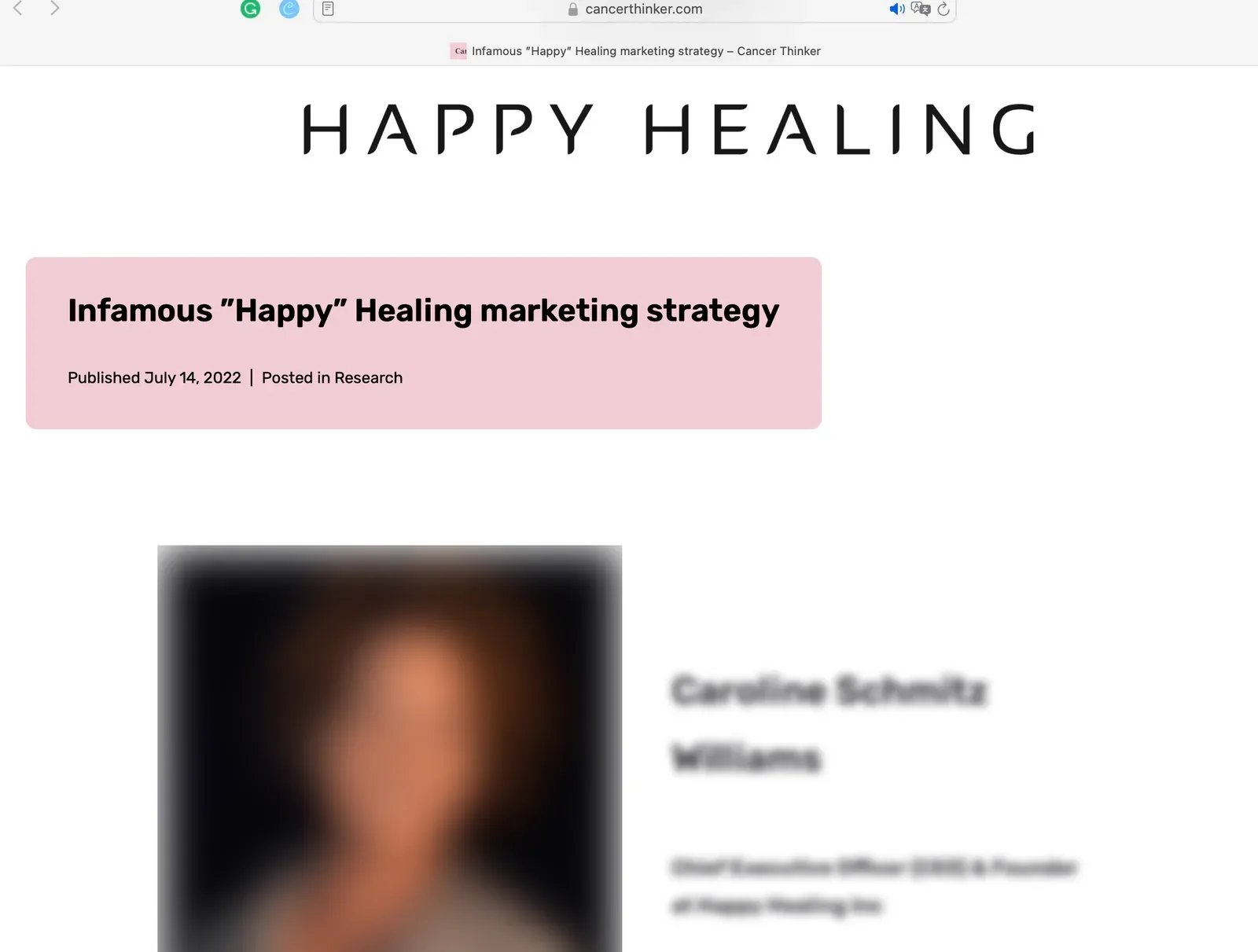
According to Happy Healing's own "laboratory science," the competition scored like this:
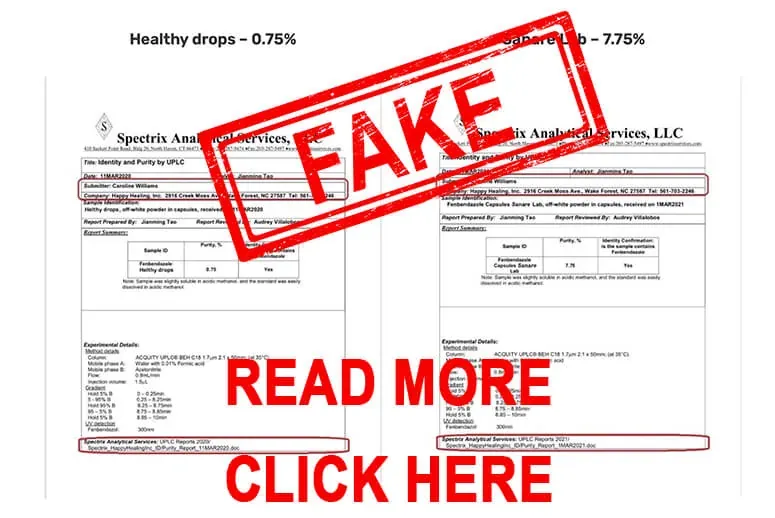
Take a moment to appreciate the artistry. Four competitors, and not one of them lands anywhere near a believable number like 96% or 98%. Instead we get a tidy little range from 0.75% to 7.75%, apparently generated by a marketing team that had recently fallen in love with the digits 7 and 5 and forgotten that other numbers exist. Meanwhile, Happy Healing's own powder is a pristine, laboratory-shattering 100% — a figure so pure it would make the analytical chemists at Sigma-Aldrich spit out their coffee, since even they sell reference-grade Fenbendazole at "≥98%."
How We Know: The Real Report
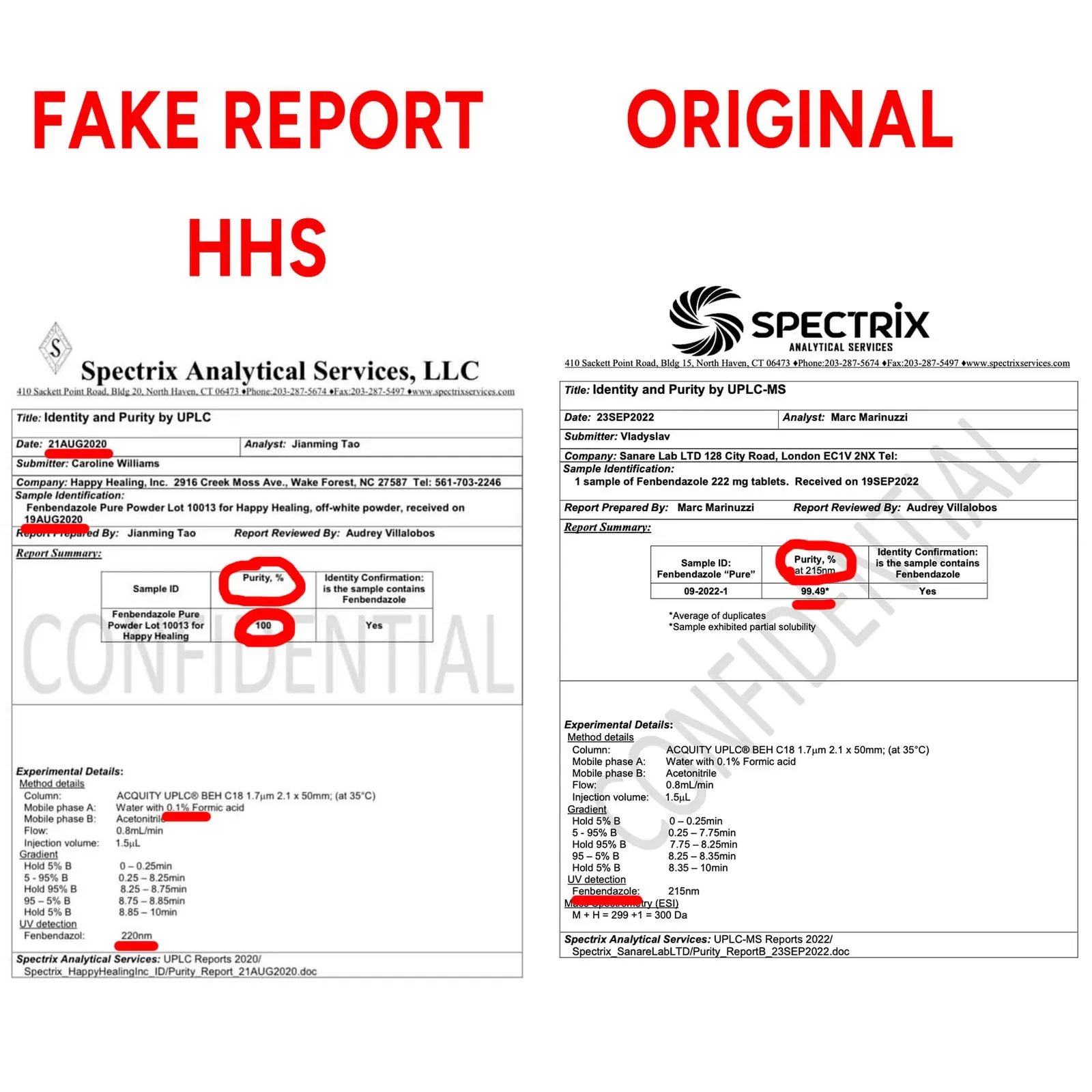
Happy Healing made one incorrect assumption — that nobody would ever order a real test. In August 2022, Sanare Lab LTD sent a fenbendazole sample from its production batch to the actual Spectrix Analytical Services. The genuine result, issued in September 2022, was 99.49% purity — verified by UPLC-MS, complete with a chromatogram and mass-spec confirmation.
So on one side we have a real, two-page, instrument-backed report showing 99.49%. On the other, a one-page JPEG claiming 7.75%. Let's put them side by side and let the details do the talking.
The Forgery, Detail by Embarrassing Detail
1. A report for a product that didn't exist yet
This is the one that ends the debate. Sanare Lab LTD began selling fenbendazole in August 2021. Happy Healing's "Spectrix report" for Sanare Lab is dated 1 March 2021 — a full five months before the product went on sale. So the obvious question: what, exactly, did anyone test five months before there was anything to buy? The answer writes itself. You cannot analyze a sample that does not exist. Unless, of course, your "laboratory" is a layer in Photoshop.
2. The submitter is… Happy Healing
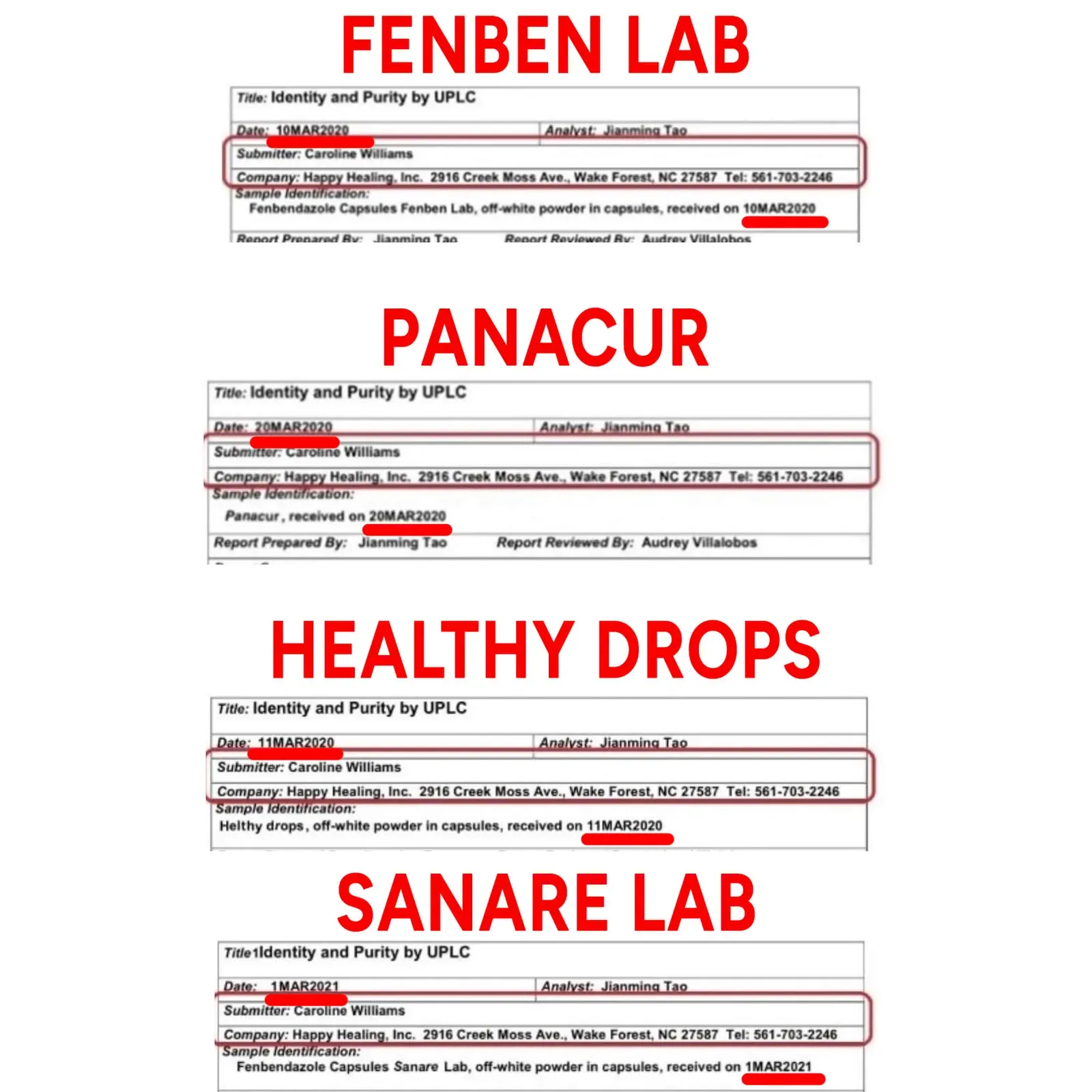
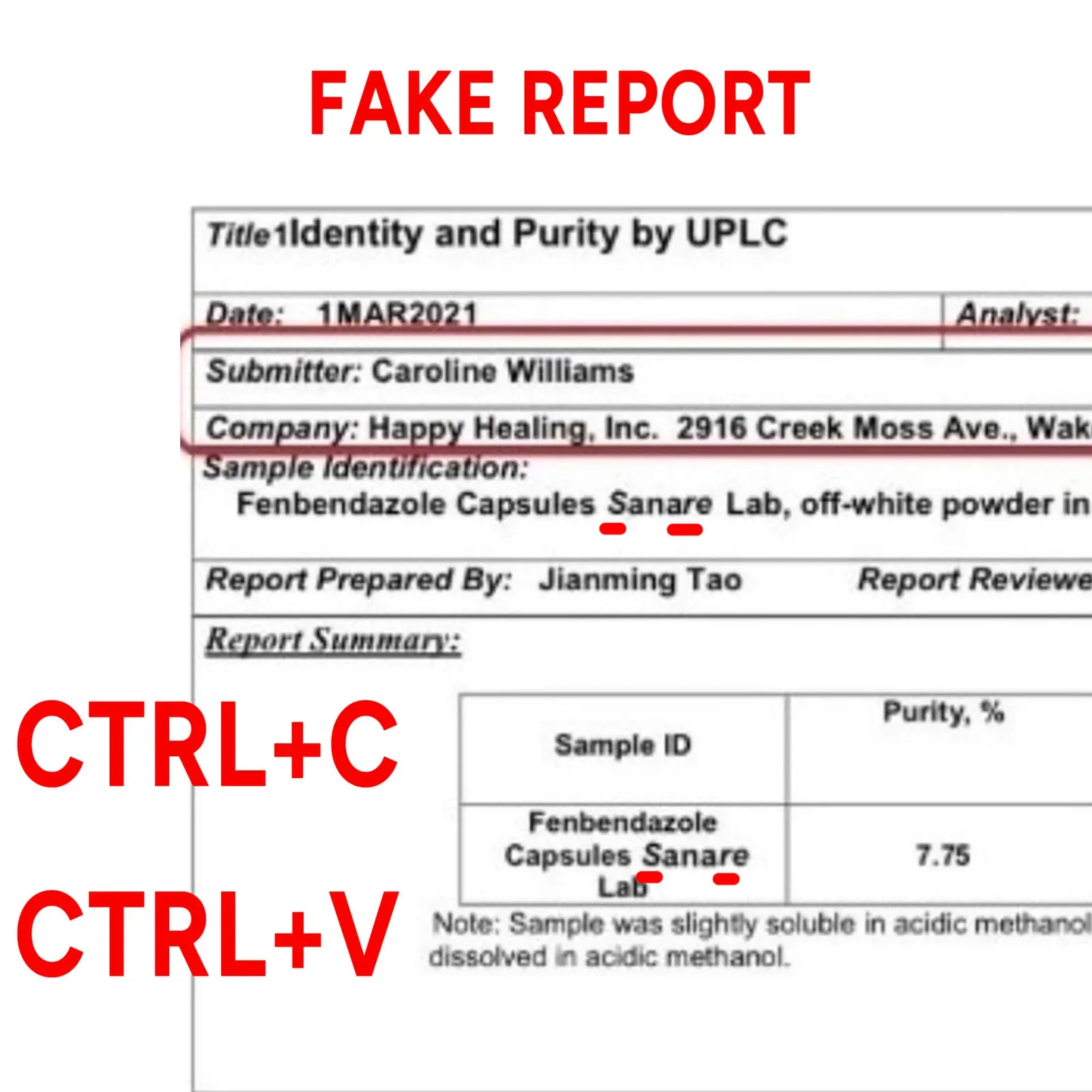
Every "independent" competitor report carries the same submitter line: Caroline Williams, Happy Healing, Inc., 2916 Creek Moss Ave., Wake Forest, NC. An independent purity comparison, in which the party commissioning the tests on all four competitors is the one competitor that magically scores 100%. Nothing says "unbiased science" like grading your rivals' homework yourself.
3. Analyses that took less than a day
In every fake, the report date equals the sample-received date. Panacur's sample was "received" on 20 MAR 2020, and its report is dated… 20 MAR 2020. That implies the sample arrived, was logged, dissolved, run through UPLC, interpreted, written up, reviewed, and stamped — all in a matter of hours. In the real world, analytical turnaround runs from several days to weeks. The genuine Sanare Lab report proves it: sample received 19 SEP 2022, report dated 23 SEP 2022. Four days. Happy Healing's competitors, apparently, got same-day service that no laboratory on Earth actually offers.
4. Ctrl+C, Ctrl+V — the smoking keyboard
On the real report, "Sample Identification" and "Sample ID" are written independently. On the fake, the "Sample Identification" text is character-for-character identical to the "Sample ID" field — right down to the italicized two letters in "Sanare." That is not how a lab types a document twice. That is what happens when someone copies a string and pastes it. The forger's mastery of Ctrl+C and Ctrl+V is, admittedly, flawless.
5. "Purity, %" — followed by a suspicious void
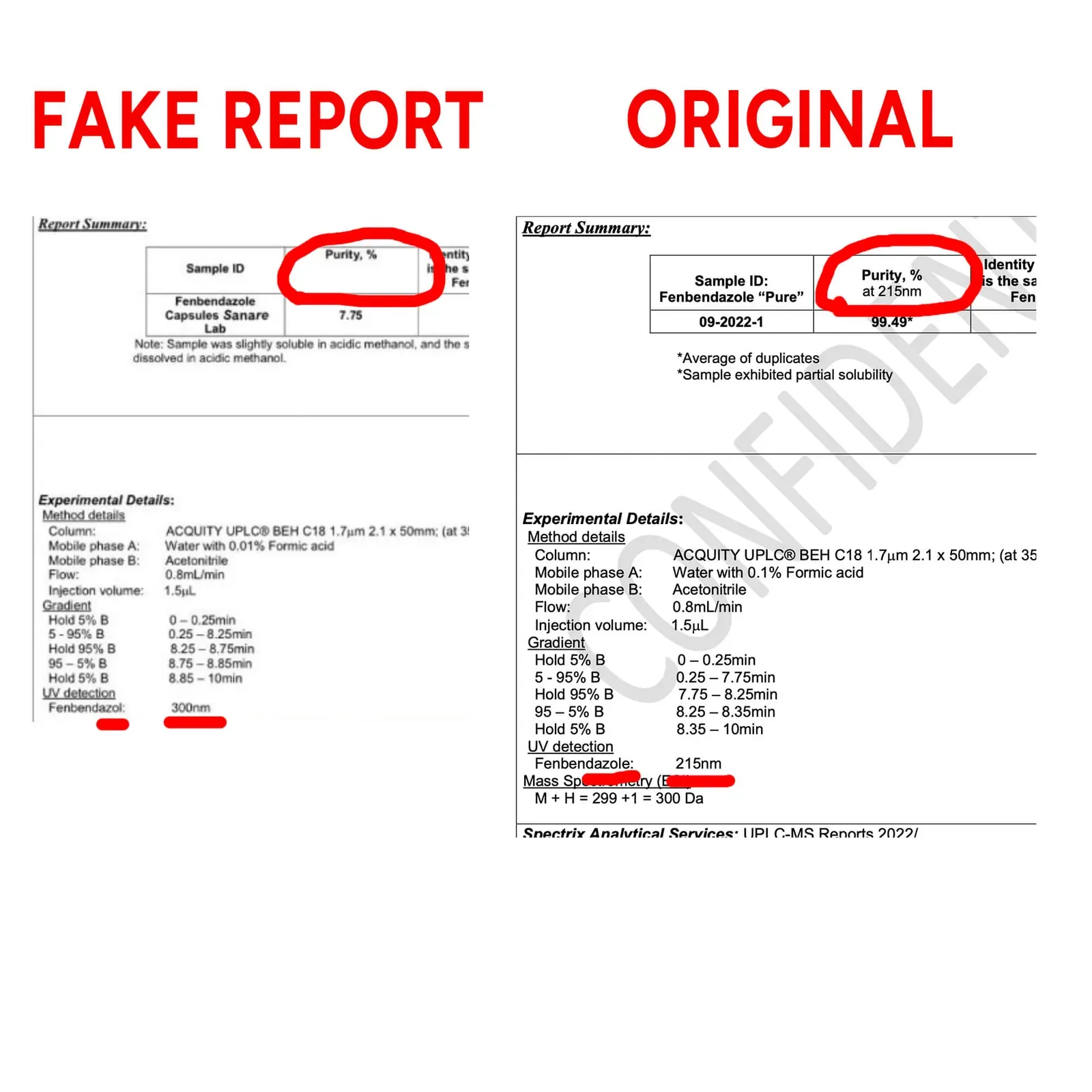
The genuine report labels its middle column "Purity, % at 215 nm" — because purity by UV detection must state the wavelength. The fake just says "Purity, %" and then… nothing. An awkward empty space where the wavelength should be. It should have read "at 300 nm," because the fake's own Experimental Details list UV detection at 300 nm. The forger copied the header but forgot to finish the lie.
6. "Fenbendazol" — the missing 'e'
The real report spells the compound correctly: Fenbendazole. The fake, in the UV-detection line, writes "Fenbendazol" — missing the final "e." A working analytical laboratory does not misspell the single molecule its entire business is built around.
7. The formic acid that shrank 10×
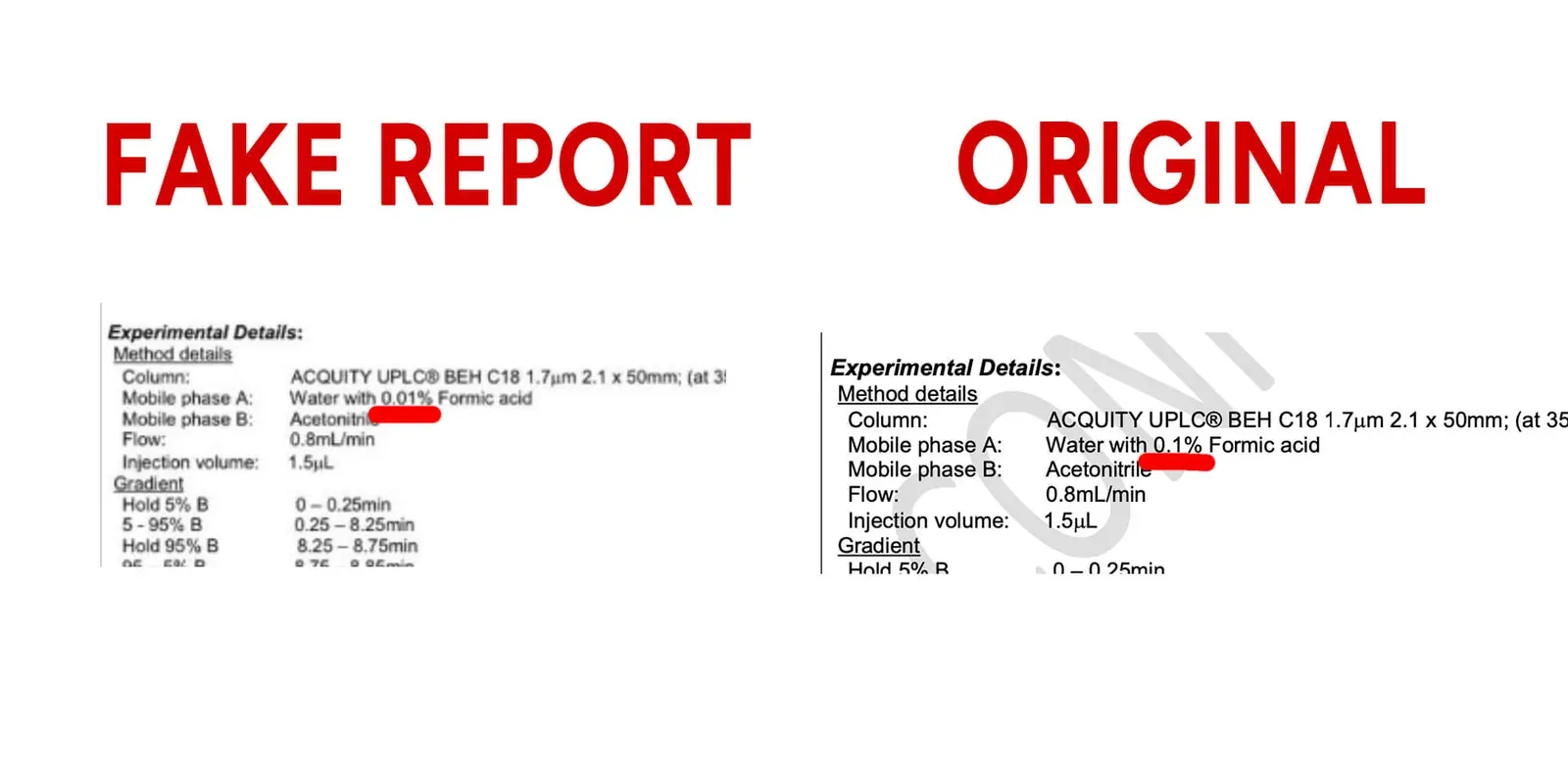
Mobile phase A in the genuine Sanare Lab report is "Water with 0.1% Formic acid" — a completely standard LC mobile phase. In the competitor fakes it reads "Water with 0.01% Formic acid" — off by a factor of ten. Curiously, Happy Healing's own self-congratulatory 100% report gets the concentration right at 0.1%. Almost as if the fakes were edited by someone who fat-fingered a decimal point while doctoring everyone else's numbers.
8. The two-page report that lost a page
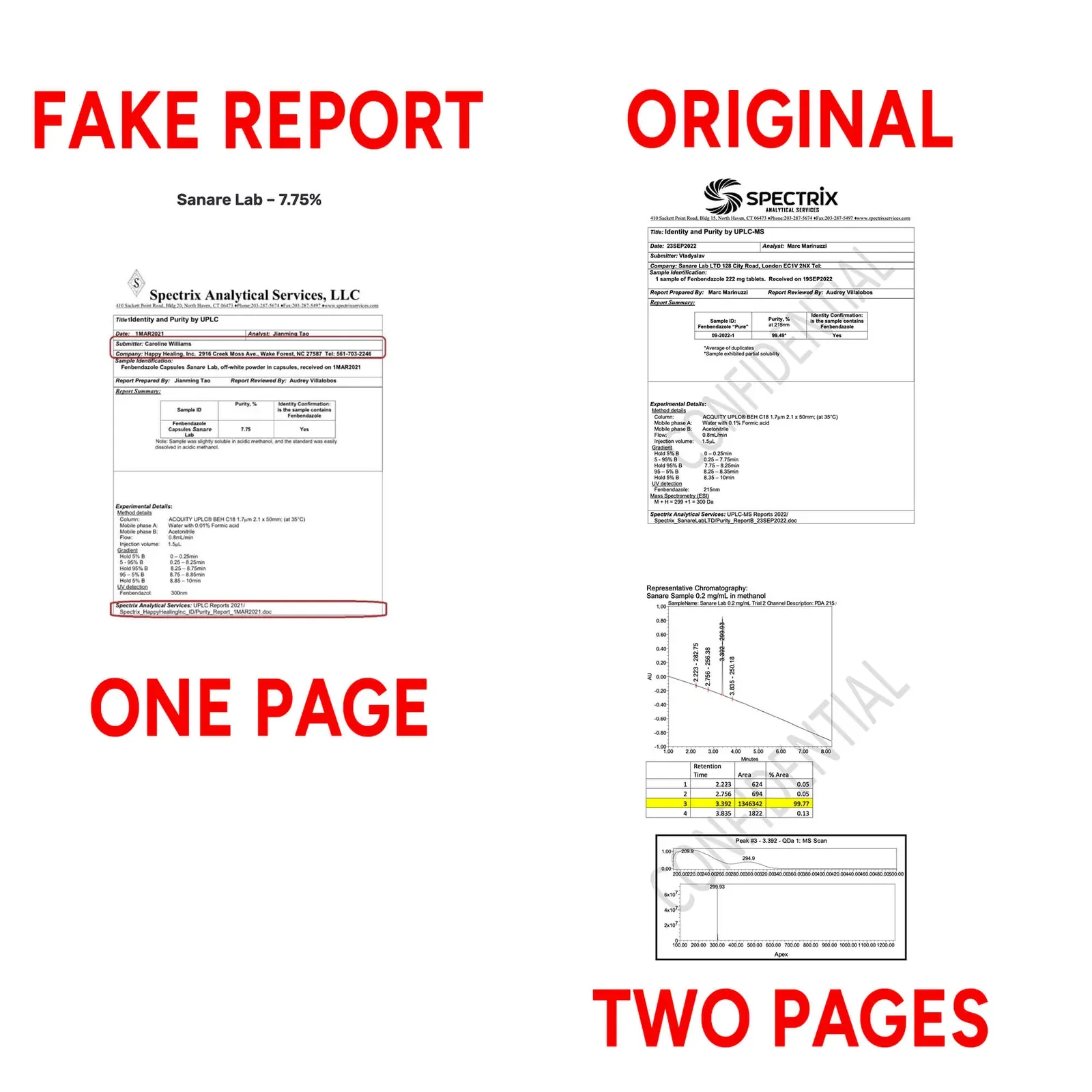
A real UPLC-MS report from Spectrix is two pages: page one carries the summary, page two carries the chromatography traces and mass spectra — the parts that actually prove what's in the vial and are extremely hard to fake. Happy Healing's forgeries are one page only. Page two — the scientific evidence — simply vanished. You can retype a date and a number on page one. You cannot fabricate a convincing chromatogram, so they didn't try.
9. The self-portrait: 100% purity and other miracles
Happy Healing's report on itself is a study in self-love. Purity: a flat, unqualified 100% — a number no honest analytical lab prints, because nothing is ever exactly 100.00%. For comparison, Sigma-Aldrich, a global reference-standard supplier, lists Fenbendazole at "≥98%." Their own report also — unlike the competitor fakes — bears the "Confidential" watermark that appears on the genuine Sanare report, and gets the formic acid right at 0.1%. The tells the forger avoided on their own document are exactly the ones they botched on everyone else's.
Why This Matters
These are not harmless marketing exaggerations. Fabricated purity reports steer seriously ill people toward one seller and away from others based on invented data. When the audience is cancer patients making high-stakes decisions, manufacturing fake evidence isn't "competitive marketing" — it's the deliberate weaponization of desperation.
They Didn't Only Come for Us — Fenben Lab Deserves a Word
It would be easy to treat this as a story about Happy Healing versus Sanare Lab. It isn't. The same forged template was used to assign Fenben Lab a fictional 7.05% and Panacur a fictional 5.05%. For the record: Sanare Lab does not endorse, participate in, or benefit from black-PR campaigns against Fenben Lab. We regard Fenben Lab as an honest, professional competitor, and we're glad to compete with them on price and quality in the open market — not in a Photoshop file. Smearing them with invented lab data is exactly the behavior we're calling out here, and it's just as indefensible when the target is a rival we respect.
Don't Take Our Word For It — Read Theirs
A company this comfortable inventing lab data for its rivals is worth checking on for how it treats its own paying customers. So we went and read the public record — Trustpilot, ComplaintsBoard, and Reddit — and pulled the actual reviews, with names and dates. No paraphrasing. Here is what real people wrote.
The Trustpilot pattern: five stars or one star, nothing in between
As of this writing, "happy healing" holds a 4.2 rating across just 42 reviews on Trustpilot — with a distribution that is a statistical curiosity: 84% five-star, 0% four-star, 0% three-star, 2% two-star, and 14% one-star. Genuine, organic review profiles almost always have a middle. A profile that is either glowing or furious, with nothing in between, is the shape you get when enthusiastic marketing sits on top of a real undercurrent of angry customers. For comparison, on the same platform Fenben Lab — the competitor Happy Healing "tested" at 7.05% — holds a 4.8 rating across roughly 3,000 reviews.
And the one-star reviews are specific:
"Happy healing lol more like happy to take your money , avoid this company or any other company that doesn't have a satisfaction guarantee because that means they have no faith that you will love there products … mark my words they don't care."— David Leyva, ⭐ (1/5), Trustpilot
"Terrible customer service…avoid. I ordered a product through their website, it didn't make it through customs in NZ due to restrictions. I requested they authorize it to be shipped back for a refund and I would pay for the shipping. They denied this due to term and conditions … Simply put, they don't care about their customers only the sale and making money. … it seems avoidance and ignoring the issue is part of their customer service strategy."— C. Desmond (New Zealand), ⭐ (1/5), Trustpilot, May 13, 2026
"I placed an order on July 11, 2023, the package … was not delivered … they said ok, we will issue a refund now. … still no money back on my account, called my bank they confirmed that the store have not issued a refund. It's now January 2024 and I still don't have a refund, I send another email they are ignoring my emails. Terrible customer service and company."— Verified Trustpilot reviewer, ⭐ (1/5), posted July 2023
"Zero communication. I didn't understand if my product would ever reach me… I will look for another supplier."— Jessica Nichols, ⭐ (1/5), Trustpilot, Sept 26, 2024
"If i could give it 0 stars I would because I've tried to use it and all it does is make me feel horrible I can't stop going to the bathroom and the smell is so strong and potent definitely will just be going to the GNC from now on big red flag."— Kelly Moore, ⭐ (1/5), Trustpilot, Jul 15, 2025
ComplaintsBoard: a refund saga and elevated liver enzymes
On ComplaintsBoard, where Happy Healing, Inc. sits at an overall 1.0 / 5.0, a customer named D. Parisian filed a complaint (June 2023) over a $267.79 order that never got refunded:
"We tried to get a refund but they didn't answer our calls or online messages. … A manager named Craig called on 3/16/22 and said they would send a check for the refund, but we haven't received anything yet. … Don't buy from Happy Healing, Inc because they don't care about their customers."— D. Parisian, ComplaintsBoard, June 20, 2023
The same customer added a detail worth remembering next to a "100% pure and totally safe" marketing claim:
"The supplement made my husband's liver enzymes go up a lot and we didn't know it was because of the supplement. We had to get an ultrasound and an MRI which cost a lot of money."— D. Parisian, ComplaintsBoard
Reddit: an analytical chemist runs the numbers
The broader market gives the forgery its context. In a widely cited r/Supplements post, a user identifying as an analytical chemist (u/TheProfessorOfNames) ran UPLC-PDA on a "pure" fenbendazole product a relative had bought online:
"The product she received was only 56% pure! That's unacceptable. … I identified what constitutes the majority of the remaining 44% as sodium carbonate."— u/TheProfessorOfNames, r/Supplements
That is exactly why fabricating reassuring purity numbers is so cynical: in this market, the gap between the label and the vial can be measured in a real laboratory — and it is often enormous. Meanwhile, across r/Fenbendazole and r/Supplements, the standing advice to new buyers is consistent: demand a real, batch-specific, third-party Certificate of Analysis, and don't trust vendor marketing.
It's Not Just Unethical — It's Illegal
Marketing an unapproved drug with disease-cure claims violates FDA rules, and publishing fabricated comparative "test results" to disparage competitors runs headlong into the FTC's prohibitions on deceptive advertising and false disparagement of a competitor's goods.
How to Spot a Fake Certificate of Analysis
Since Happy Healing kindly provided a masterclass in what not to trust, here's how any buyer can separate a real Certificate of Analysis (CoA) from a Photoshop special:
The Verdict
Words like integrity, honesty and honor appear to be foreign vocabulary at Happy Healing Store. What their 2020–2022 forgery campaign demonstrates fluently is a different skill set: fabrication, misspelling, and an over-reliance on the numbers 7 and 5. Sanare Lab has never smeared a competitor and never will. We compete the old-fashioned way — better quality, fair price, and lab reports that survive a second page. If a company has to invent your bad results to sell its own product, that tells you everything you need to know about the product.
You can map out a weight-based schedule using our dosage calculator.
Frequently Asked Questions
Did Happy Healing really publish these reports?
Yes. The comparison reports were published in July 2022 in a paid placement on cancerthinker.com titled "Infamous Happy Healing marketing strategy," alongside Happy Healing's own promotional material.
What is Sanare Lab's real, verified purity?
99.49%, confirmed by an independent UPLC-MS report from Spectrix Analytical Services (sample received 19 Sept 2022, report dated 23 Sept 2022), including a chromatogram and mass-spectrometry confirmation.
What's the single most damning detail?
The Sanare Lab "report" is dated 1 March 2021, but Sanare Lab did not begin selling fenbendazole until August 2021. You cannot test a product that will not exist for another five months.
How can I verify any seller's purity claim myself?
Demand a batch-specific Certificate of Analysis from an independent, ISO 17025-accredited lab that includes the HPLC/UPLC chromatogram — not a one-page summary, not an in-house number, and definitely not a competitor-submitted document. See our guide to buying and verifying fenbendazole.
Shop Sanare Lab
Lab-tested products referenced in the research above. Links are provided for convenience — always review the label and consult a professional before use.
180 capsules — 99% purity, laboratory tested
180 capsules — higher-dose option
120 capsules — with Black Pepper for absorption
Disclaimer: Links are informational and for convenience. This site does not provide medical advice and does not endorse any specific vendor. Always verify product quality, labeling, and consult a licensed professional for health decisions.
References
- Spectrix Analytical Services, LLC. Identity and Purity by UPLC-MS — Sanare Lab LTD sample (received 19 SEP 2022, report dated 23 SEP 2022). Result: 99.49% fenbendazole.
- U.S. Food & Drug Administration. "Unapproved New Drugs" and health-fraud enforcement. fda.gov
- U.S. Federal Trade Commission. Truth in Advertising / deceptive and disparaging claims. ftc.gov
- Trustpilot — customer reviews of thehappyhealingstore.com (4.2 / 42 reviews; reviewers quoted: David Leyva, C. Desmond, Jessica Nichols, Kelly Moore). trustpilot.com/review/thehappyhealingstore.com
- Trustpilot — Fenben Lab profile (4.8 / ~3,000 reviews), for comparison. trustpilot.com/review/fenbenlab.com
- ComplaintsBoard — Happy Healing, Inc. (overall 1.0/5.0; complaint by D. Parisian, June 20, 2023). complaintsboard.com/happy-healing-b153482
- Better Business Bureau — Happy Healing, Inc. profile and complaints (Wake Forest, NC). bbb.org
- Reddit r/Supplements — u/TheProfessorOfNames, "I'm an analytical chemist and I just performed…": independent test finding 56% fenbendazole, 44% sodium carbonate. reddit.com
- Sigma-Aldrich — Fenbendazole reference standard, listed purity ≥98%. sigmaaldrich.com
Medical Disclaimer
This article is for educational and informational purposes only. It is not intended to be a substitute for professional medical advice, diagnosis, or treatment. Always seek the advice of your physician or other qualified health provider with any questions you may have regarding a medical condition. Never disregard professional medical advice or delay in seeking it because of something you have read on this website.

Dr. Andrew Ellison, MD
Science editor and health researcher at Sanare Lab, covering evidence-based wellness, emerging compound research, clinical studies, and practical health protocols. Content is educational and does not replace medical advice.