Methylene blue (methylthioninium chloride) is one of the oldest synthetic compounds still actively used in medicine. First synthesized in 1876 by German chemist Heinrich Caro at BASF, it was originally developed as a textile dye but rapidly attracted scientific attention due to its unique chemical properties — specifically, its ability to participate in reversible oxidation-reduction (redox) reactions. Over more than a century, methylene blue has evolved from an industrial chemical to a regulated pharmaceutical, FDA-approved diagnostic agent, and subject of ongoing biomedical research.
This article covers methylene blue's chemical properties, its historical journey through medicine, its safety profile and drug interactions, and why modern formulations like capsules have emerged to address practical challenges with liquid forms. For a detailed examination of methylene blue's role in experimental oncology and photodynamic therapy research, see our companion article on methylene blue in experimental cancer models.
Chemical Identity and Redox Properties
Methylene blue belongs to the phenothiazine family of heterocyclic compounds. Its molecular formula is C₁₆H₁₈ClN₃S, and it is characterized by an intense blue color in its oxidized state. When reduced, it forms leucomethylene blue — a colorless compound. This reversible redox cycling between oxidized and reduced forms is the foundation of nearly all its biological and medical applications.
In biological systems, methylene blue acts as an electron carrier. It can accept electrons from NADH and transfer them to molecular oxygen or to components of the mitochondrial electron transport chain (ETC), particularly cytochrome c. This property allows it to bypass damaged segments of the ETC, which is why it effectively treats methemoglobinemia — restoring the oxygen-carrying capacity of hemoglobin by converting methemoglobin back to its functional form.
Methylene blue is water-soluble, relatively stable in solution, and has a high affinity for biological tissues, which also accounts for its widespread use as a histological stain in laboratory research and diagnostic procedures.
Historical Timeline — From Dye to Drug
1876 — Synthesis and Industrial Use
Heinrich Caro synthesized methylene blue at BASF as part of the rapidly expanding synthetic dye industry. Its chemical stability and vivid color made it commercially successful, but its biological staining properties soon attracted the attention of scientists working at the intersection of chemistry and medicine.
Late 19th Century — Early Medical Exploration
Paul Ehrlich, one of the founders of chemotherapy, recognized that methylene blue selectively stained certain cells and microorganisms. He used it in some of the earliest experiments exploring the idea that chemical compounds could target specific pathogens — work that laid the conceptual groundwork for modern antimicrobial therapy. Ehrlich also tested methylene blue as a treatment for malaria, with modest success.
20th Century — Diagnostic and Surgical Applications
Throughout the 1900s, methylene blue became a standard tool in surgery and diagnostics. Surgeons used it to visualize tissue boundaries, identify lymph nodes, and trace fistula tracts. In pathology laboratories, it served as a versatile biological stain for cellular microscopy. These applications remain current today.
FDA Approval for Methemoglobinemia
The most important clinical milestone was FDA approval of methylene blue (as Provayblue®) for treating acquired methemoglobinemia. In this condition, an abnormal form of hemoglobin accumulates in the blood, impairing oxygen delivery to tissues. Intravenous methylene blue at 1–2 mg/kg rapidly reverses this condition by acting as an electron carrier in the NADPH-methemoglobin reductase pathway.
Current Medical and Research Applications
Today, methylene blue is used across several medical and scientific domains. In hospital settings, it remains the first-line treatment for symptomatic methemoglobinemia. It is also used intraoperatively as a tissue dye for sentinel lymph node mapping in cancer surgery and for identifying anatomical structures during complex procedures.
In research, methylene blue continues to be studied for its effects on mitochondrial function, cellular senescence, and neuroprotection. Its ability to modulate mitochondrial electron transport has attracted interest from neuroscience researchers investigating Alzheimer's disease and other neurodegenerative conditions. Separately, its photosensitizing properties have made it a focus of photodynamic therapy (PDT) research in preclinical cancer models.
Methylene blue also appears in several experimental combination frameworks, including the ISOM Protocol — a metabolic approach that combines repurposed drugs for investigational oncology support. It is important to emphasize that oncology applications remain strictly experimental and are not supported by clinical evidence.
Safety Profile and Drug Interactions
Methylene blue has a well-documented safety record spanning over a century of clinical and laboratory use. At approved therapeutic doses (typically 1–2 mg/kg IV for methemoglobinemia, or 12–50 mg orally in supplement contexts), it is generally well tolerated. The most common effects include temporary blue-green discoloration of urine, mild nausea, and transient headache.
However, methylene blue's safety is dose-dependent. At higher concentrations, it can paradoxically worsen methemoglobinemia and may cause hemolytic anemia — particularly in individuals with glucose-6-phosphate dehydrogenase (G6PD) deficiency. This genetic enzyme deficiency is relatively common and should be screened for before methylene blue administration.
Critical Interaction: Serotonergic Medications
The most important drug interaction involves serotonergic medications. Methylene blue is a potent monoamine oxidase (MAO) inhibitor, and when combined with SSRIs, SNRIs, MAOIs, or other serotonergic agents, it can precipitate serotonin syndrome — a potentially life-threatening condition characterized by agitation, hyperthermia, rigidity, and autonomic instability. The FDA has issued specific warnings about this interaction, and patients taking any serotonergic medication should not use methylene blue without direct medical supervision.
Other medications that may interact include sympathomimetics and certain anesthetic agents. Patients should disclose all medications to their healthcare provider before methylene blue administration. For a broader perspective on drug safety in antiparasitic and repurposed-drug contexts, see our articles on ivermectin safety guidelines and fenbendazole dosage safety.
Available from Sanare Lab
Modern USP-grade formulations referenced in this article — capsules and liquid drops.
60 capsules with Vitamin C + Organic Cocoa Powder
10 mg USP Grade — 60 mL (2 fl oz)
Disclaimer: For convenience only. Consult a licensed professional.
Why Modern Formulation Matters
Historically, methylene blue was administered as a liquid solution — either intravenously in clinical settings or as oral drops in research and supplement contexts. Liquid formulations present practical challenges: the compound's intense staining properties can discolor skin, clothing, and surfaces, and accurate dosing requires careful measurement.
Modern capsule formulations address these issues by providing pre-measured doses in a sealed, non-staining format. Benefits include accurate dosing without measuring equipment, elimination of staining risk, improved shelf stability, and convenience for daily use. Vegetarian cellulose capsules are available for those avoiding gelatin-based products.
Blue Essence — Capsule Formula Overview
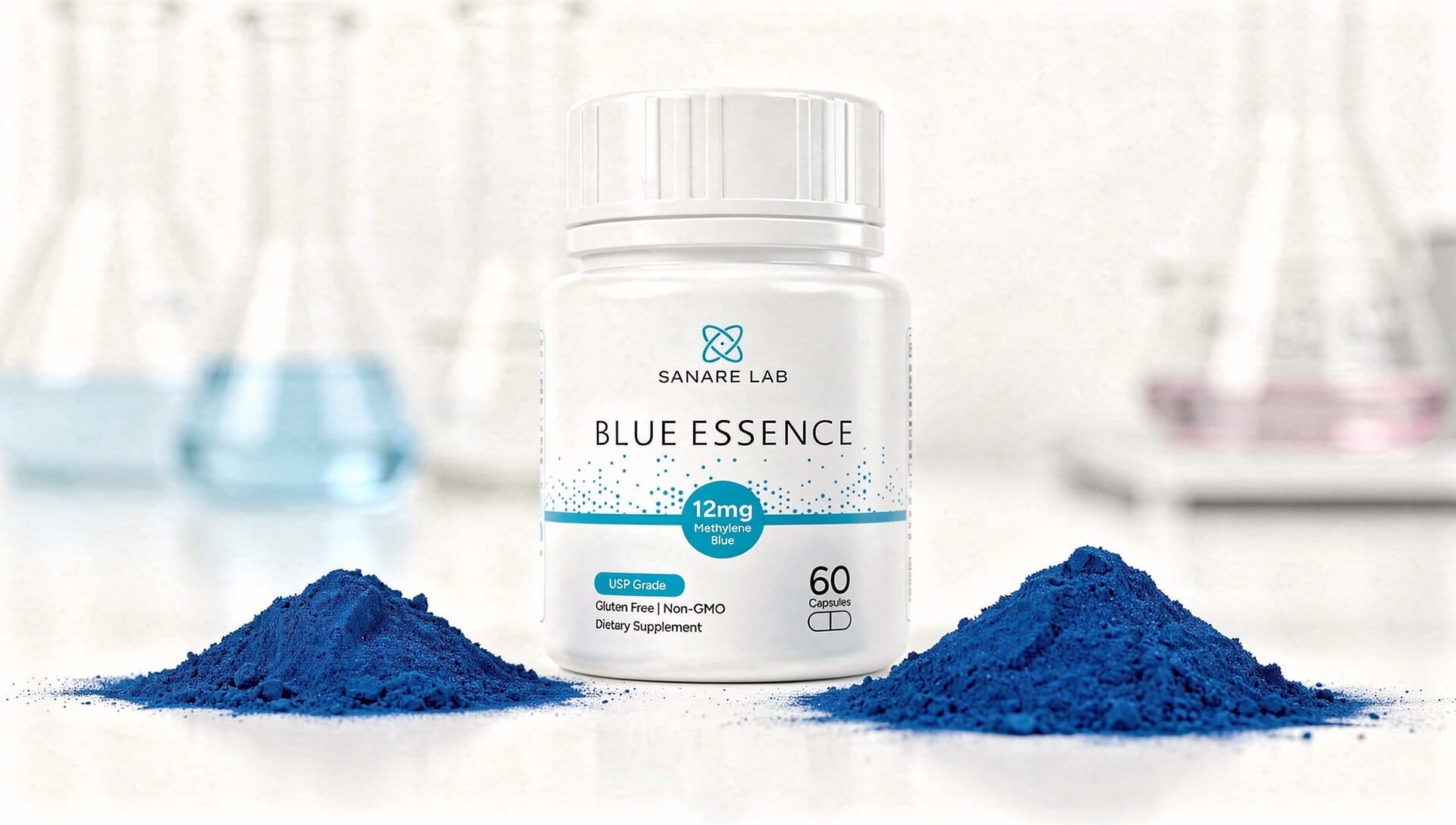
Blue Essence is a methylene blue supplement offered in capsule form, designed for precise dosing and daily convenience. Each capsule contains 12 mg of methylene blue, 35 mg of Vitamin C (as ascorbyl palmitate — a fat-soluble, stable form), and 235 mg of organic cocoa powder, which provides natural polyphenols and supports formulation integrity. The product is non-GMO, gluten-free, vegetarian-friendly, and manufactured in the USA.
For those who prefer liquid delivery, Blue Essence is also available as USP-grade liquid drops (10 mg, 60 mL). Both formats use pharmaceutical-grade methylene blue.
Important: Methylene blue supplements are intended for adult use only. Do not use if taking SSRIs or MAOIs. Not intended for pregnant or nursing women. Consult a healthcare professional before use. Temporary changes in urine color are normal and expected.
Scientific References
- Schirmer, R.H. et al. (2011). "Lest we forget you — methylene blue…" Neurobiology of Aging, 32(12), 2325.e7–2325.e16. PubMed
- Oz, M. et al. (2011). Cellular and molecular actions of methylene blue in the nervous system. Medicinal Research Reviews, 31(1), 93–117. PubMed
- Atamna, H. et al. (2008). Methylene blue delays cellular senescence and enhances key mitochondrial biochemical pathways. The FASEB Journal, 22(3), 703–712. PubMed
- Clifton, J., Leikin, J.B. (2003). Methylene blue. American Journal of Therapeutics, 10(4), 289–291. PubMed
- Ramsay, R.R. et al. (2007). Methylene blue and serotonin toxicity: inhibition of monoamine oxidase A (MAO A) confirms a theoretical prediction. British Journal of Pharmacology, 152(6), 946–951. PubMed
Protocol Stack (Quick Links)
Below are commonly referenced items mentioned in this article. Links are provided for convenience — always review the label and consult a professional before use.
60 capsules with Vitamin C + Organic Cocoa Powder
10 mg USP Grade — 60 mL (2 fl oz)
Disclaimer: Links are informational and for convenience. This site does not provide medical advice and does not endorse any specific vendor. Always verify product quality, labeling, and consult a licensed professional for health decisions.