
Fenbendazole for Bladder Cancer: Research Review 2026
Preclinical research on fenbendazole for bladder cancer: the 2026 photothermal ferroptosis nanoplatform study, mechanisms, and honest evidence limits.
 By Sanare Lab · September 23, 2026 · 12 min read
This article is for research and informational purposes only. It does not constitute medical advice. Do not self-prescribe. Always consult a qualified healthcare provider before using any supplement, especially alongside cancer treatment.
Key Takeaway
Preclinical research suggests fenbendazole may have anti-tumour activity in bladder cancer. A 2026 Advanced Science study combined fenbendazole with photothermal therapy in a nanoparticle to trigger ferroptosis in an orthotopic mouse model, and a 2024 study paired it with CRISPR-Cas13a for intravesical delivery. All evidence is preclinical (cells and mice) — there are no human trials, and fenbendazole is not an approved bladder-cancer treatment.
Bladder cancer is one of the most common urological cancers and is notorious for high recurrence rates after standard treatment, which keeps researchers looking for new, locally delivered options. That search has drawn attention to repurposed drugs, including the benzimidazole anthelmintic fenbendazole. This review builds on our news brief covering the 2026 fenbendazole photothermal-ferroptosis bladder-cancer study and places it alongside the wider preclinical evidence. For how fenbendazole is being studied across other tumour types, see our fenbendazole by cancer type hub.
Everything below is preclinical — laboratory cells and animal models. None of it establishes that fenbendazole treats bladder cancer in people. If you are exploring dosing concepts for research reading, our protocol and dosing workspace lays out the commonly cited regimens, but it is educational only and not a substitute for oncology care.
Table of Contents
- Why Bladder Cancer Is a Target for Drug Repurposing
- Bladder Cancer by the Numbers
- Intravesical Therapy: Treating the Bladder Locally
- Where Proven Treatment Stands Today
- The 2026 Fenbendazole Nanoplatform Study
- How Fenbendazole Attacks Cancer Cells
- Other Benzimidazole Bladder-Cancer Research
- What Would Have to Happen Before Human Use
- What This Means If You Have Bladder Cancer
- Safety: What Human Case Reports Show
- Questions to Ask Your Oncologist
- Evidence Level and Limitations
- What People Report Online: Bladder Cancer
- Frequently Asked Questions
- References
Why Bladder Cancer Is a Target for Drug Repurposing
Non-muscle-invasive bladder cancer is often treated by removing the tumour and then instilling drugs directly into the bladder (intravesical therapy). This route is attractive because it concentrates a drug at the tumour while limiting whole-body exposure. Even so, recurrence is common, and some patients do not respond to standard intravesical agents such as BCG. Repurposing an inexpensive, well-characterised drug that can be delivered locally is therefore an active research idea — and it is exactly the niche where benzimidazoles like fenbendazole are being tested preclinically.
Bladder Cancer by the Numbers
Bladder cancer is one of the ten most frequently diagnosed cancers worldwide, according to the International Agency for Research on Cancer’s GLOBOCAN 2022 estimates (Bray et al., 2024). A large share of cases are found while the tumour is still confined to the inner lining of the bladder — so-called non-muscle-invasive disease.
Recurrence is the defining problem. In a pooled analysis of 2,596 patients from seven EORTC trials, the chance of the cancer coming back after surgical removal ranged from 15% to 61% at one year and from 31% to 78% at five years, depending on the tumour’s features; the five-year risk of progression to more invasive disease ranged from under 1% to 45% (Sylvester et al., 2006). This is why patients face years of camera checks (cystoscopy) and repeated treatment — and why researchers keep looking for new, locally delivered options.
Intravesical Therapy: Treating the Bladder Locally
A key reason the bladder is a natural testing ground for repurposed drugs is that it can be treated from the inside. In intravesical therapy, a drug is instilled directly through a catheter into the bladder and held there, bathing the tumour and the bladder lining in a high local concentration while sparing the rest of the body. This is how standard agents such as BCG immunotherapy and intravesical chemotherapy (for example mitomycin C) are given for non-muscle-invasive disease. The same principle is what makes fenbendazole preclinically interesting here: a drug that is poorly water-soluble and modestly absorbed when swallowed can, in theory, be delivered straight to a bladder tumour if packaged appropriately. Both leading fenbendazole bladder studies exploit this — one through a light-activated nanoparticle and one through a gene-editing system — rather than relying on oral dosing.
Where Proven Treatment Stands Today
It helps to know the bar any new therapy has to clear. When high-risk non-muscle-invasive cancer stops responding to BCG, several treatments have been tested in people. In the KEYNOTE-057 trial, the immunotherapy drug pembrolizumab produced a complete response in 41% of 96 patients with BCG-unresponsive carcinoma in situ (Balar et al., 2021). An intravesical gene therapy, nadofaragene firadenovec, achieved a complete response within three months in 53.4% of 103 patients with carcinoma in situ, and 45.5% of those responders were still in response at 12 months (Boorjian et al., 2021).
For advanced urothelial cancer, the EV-302 trial of 886 patients found that enfortumab vedotin plus pembrolizumab nearly doubled median overall survival compared with platinum chemotherapy — 31.5 versus 16.1 months (Powles et al., 2024). These are human results from registered clinical trials. Fenbendazole has nothing comparable: its bladder-cancer data come only from cells and mice.
The 2026 Fenbendazole Nanoplatform Study
The anchor study for this topic was published in June 2026 in Advanced Science (Xu et al., 2026). The authors engineered a nanoplatform they call FBZ@BSA@PDA: fenbendazole (FBZ) encapsulated in a shell of bovine serum albumin (BSA) and polydopamine (PDA). Polydopamine absorbs near-infrared light and heats up, so shining a laser on the particle delivers photothermal therapy (PTT) while releasing the drug at the tumour site.
Mechanistically, the platform was designed to drive ferroptosis — an iron-dependent form of regulated cell death distinct from apoptosis — and to trigger immunogenic cell death that recruits the immune system. In an orthotopic mouse model of bladder cancer, the combination suppressed tumour growth and activated anti-tumour immune responses more than the components alone, which the authors described as a “dual-immunotherapy” effect. This is a mechanistically detailed but strictly preclinical proof-of-concept that also requires a near-infrared laser, so it is not a therapy available to patients today.
How Fenbendazole Attacks Cancer Cells
Fenbendazole’s core anticancer mechanism is shared across the benzimidazole family. It acts as a moderate microtubule-destabilising agent (Dogra et al., 2018), disrupting the cytoskeletal scaffolding that cells need to divide. Beyond that, preclinical work has linked it to interference with cancer-cell glucose metabolism, p53 stabilisation in cells with functional p53, and the generation of reactive oxygen species. In the bladder-cancer nanoplatform, these drug effects are layered on top of heat (from PTT) and iron-driven lipid peroxidation (ferroptosis), which is why the combination outperformed the individual parts in mice.
Other Benzimidazole Bladder-Cancer Research
The nanoplatform paper is not the only preclinical signal. A 2024 study in the Journal of Experimental & Clinical Cancer Research (Liang et al., 2024) described a synergistic intravesical strategy that combined CRISPR-Cas13a with fenbendazole for bladder cancer, again exploiting local delivery into the bladder. Together these studies suggest fenbendazole is being investigated less as a stand-alone pill and more as a component of engineered, locally delivered combination systems. That framing matters: the interesting results depend on the delivery technology and the partner therapy, not on fenbendazole alone.
What Would Have to Happen Before Human Use
The path from a promising mouse study to a bladder-cancer treatment is long, and fenbendazole is at the very start of it. Researchers would first need formal toxicology testing of the nanoparticle formulation, then a phase 1 trial in people to find a safe intravesical dose, and then controlled trials comparing it with — or adding it to — standard care such as BCG. As of September 2026, a search of ClinicalTrials.gov finds no registered trial of fenbendazole in bladder cancer.
It is also worth being clear about what the mouse studies did not use: an oral capsule. Both bladder studies delivered fenbendazole directly into the bladder inside an engineered carrier. Because fenbendazole is poorly water-soluble and only modestly absorbed when swallowed, results from these systems cannot be translated into an oral dose.
What This Means If You Have Bladder Cancer
For a patient reading this, the practical message is measured. The research is genuinely interesting and mechanistically detailed, but it lives entirely in cell dishes and mice, and the most striking results depend on hardware (a near-infrared laser) or gene-editing tools that are not part of routine care. There is no validated way to reproduce these experiments with an over-the-counter fenbendazole capsule. Standard, proven treatments — transurethral resection, intravesical BCG or chemotherapy, and, for advanced disease, systemic chemotherapy or immunotherapy — remain the evidence-based path. If fenbendazole interests you as an adjunct, the only responsible step is a candid conversation with your oncologist, who can factor in your liver function, current medications, and the fact that no human data support a benefit in bladder cancer.
Safety: What Human Case Reports Show
Fenbendazole is a veterinary medicine and has never been through the safety testing required for human use. What is known about its effects in people comes largely from case reports of patients who took it on their own, and several describe drug-induced liver injury. A patient with lung cancer developed liver dysfunction that resolved after stopping fenbendazole (Yamaguchi et al., 2021). Another case involved severe liver injury with weeks of jaundice; liver tests returned to normal about three months after stopping (Thakurdesai et al., 2024). A 2026 report describes a man with prostate cancer who took fenbendazole together with ivermectin and presented with ALT of 1,764 U/L and AST of 1,132 U/L — many times the normal range — which normalised within six weeks of stopping (Powderly et al., 2026). A further 2026 report describes liver injury even though the person was also taking a supplement intended to protect the liver (Satinsky et al., 2026).
The evidence base can also change. A 2025 case series in Case Reports in Oncology that described three patients who self-administered fenbendazole was retracted by the journal in January 2026 (Case Rep Oncol, 2026). When a claim online cites a paper, it is worth checking that the paper still stands.
Questions to Ask Your Oncologist
- Which treatments are recommended for my stage and risk group, and what is my risk of recurrence?
- Am I eligible for any clinical trials, including trials for BCG-unresponsive disease?
- If I am considering a supplement or an off-label drug, how could it interact with my treatment?
- Which blood tests, including liver-function tests, should be monitored?
- Bray F, Laversanne M, Sung H, et al. Global cancer statistics 2022: GLOBOCAN estimates of incidence and mortality worldwide for 36 cancers in 185 countries. CA Cancer J Clin. 2024;74:229-263. PMID 38572751.
- Sylvester RJ, van der Meijden AP, Oosterlinck W, et al. Predicting recurrence and progression in individual patients with stage Ta T1 bladder cancer using EORTC risk tables. Eur Urol. 2006;49:466-477. PMID 16442208.
- Balar AV, Kamat AM, Kulkarni GS, et al. Pembrolizumab monotherapy for the treatment of high-risk non-muscle-invasive bladder cancer unresponsive to BCG (KEYNOTE-057). Lancet Oncol. 2021;22:919-930. PMID 34051177.
- Boorjian SA, Alemozaffar M, Konety BR, et al. Intravesical nadofaragene firadenovec gene therapy for BCG-unresponsive non-muscle-invasive bladder cancer. Lancet Oncol. 2021;22:107-117. PMID 33253641.
- Powles T, Valderrama BP, Gupta S, et al. Enfortumab vedotin and pembrolizumab in untreated advanced urothelial cancer. N Engl J Med. 2024;390:875-888. PMID 38446675.
- Yamaguchi T, Shimizu J, Oya Y, et al. Drug-induced liver injury in a patient with nonsmall cell lung cancer after the self-administration of fenbendazole based on social media information. Case Rep Oncol. 2021;14:886-891. PMID 34248555.
- Thakurdesai A, Rivera-Matos L, Nagra N, et al. Severe drug-induced liver injury due to self-administration of the veterinary anthelmintic medication, fenbendazole. ACG Case Rep J. 2024;11:e01354. PMID 38706451.
- Powderly GE, Hassevoort K, Loy M, et al. Drug-induced liver injury following co-ingestion of veterinary fenbendazole and ivermectin for prostate cancer: a case report. Cureus. 2026;18:e108896. PMID 42299164.
- Satinsky A, Mayer N, Swanson C, Sasso B. Fenbendazole-associated drug-induced liver injury with concomitant use of tauroursodeoxycholic acid. ACG Case Rep J. 2026;13:e02222. PMID 42383214.
- Retraction statement: “Fenbendazole as an Anticancer Agent? A Case Series of Self-Administration in Three Patients”. Case Rep Oncol. 2026;19:169. PMID 41574240.
Evidence Level and Limitations
To be clear about where this stands: the bladder-cancer evidence for fenbendazole is entirely preclinical. It consists of cell-culture experiments and mouse models, often relying on nanoparticle delivery and external lasers that do not exist as approved clinical tools. There are no completed human clinical trials of fenbendazole for bladder cancer, no established human dose for this indication, and no regulatory approval. Fenbendazole should never replace standard bladder-cancer treatment. Anyone considering it should do so only in discussion with their oncologist, who can weigh interactions, liver-function monitoring, and the complete absence of human efficacy data.
What People Report Online: Bladder Cancer
Behind the laboratory papers sits a large, restless online conversation. On Reddit and patient forums, people living with bladder cancer — and the relatives caring for them — trade experiences with fenbendazole, usually following some version of the Joe Tippens protocol. To save you from digging through dozens of scattered threads, we have gathered the most relevant, on-topic discussions in one place, together with an honest guide to what these accounts can and cannot tell you.
How to read these reports
These are personal stories, not clinical evidence. They are uncontrolled, self-reported, and impossible to verify independently.
In almost every account, the person was also receiving standard treatment — chemotherapy, immunotherapy, radiotherapy, or surgery — at the same time as fenbendazole. When someone improves on two therapies at once, the result cannot be credited to fenbendazole alone; the conventional treatment is the far more likely explanation.
Encouraging stories are also shared far more often than disappointing ones, so online threads skew positive (survivorship and publication bias).
The useful way to read them is as questions worth raising with your oncologist — not as a protocol to copy on your own.
For a deeper, evidence-based look at how these accounts hold up — including the documented case reports and the peer-reviewed analyses behind them — see our detailed review of fenbendazole success stories and case reports.
Frequently Asked Questions
Does fenbendazole treat bladder cancer?
There is no proof that it treats bladder cancer in people. The evidence is preclinical — cell and mouse studies, including a 2026 nanoparticle study combining fenbendazole with photothermal therapy. No human clinical trials have been completed, and it is not an approved treatment.
What did the 2026 Advanced Science study actually show?
It showed that a nanoparticle carrying fenbendazole (FBZ@BSA@PDA), activated by near-infrared light, suppressed tumour growth and triggered ferroptosis plus an immune response in an orthotopic mouse model of bladder cancer. It is a preclinical proof-of-concept that requires a laser and has not been tested in humans.
What is ferroptosis?
Ferroptosis is a form of regulated cell death driven by iron-dependent accumulation of lipid peroxides. It is distinct from apoptosis and necrosis, and it is the main cell-death pathway the 2026 bladder-cancer nanoplatform was designed to trigger.
Can I use fenbendazole instead of BCG or chemotherapy for bladder cancer?
No. Fenbendazole should not replace standard treatments such as intravesical BCG, chemotherapy, surgery, or immunotherapy. There is no human efficacy data for bladder cancer. Discuss any investigational interest with your oncologist rather than substituting proven care.
Is there a recommended fenbendazole dose for bladder cancer?
No established human dose exists for bladder cancer, because fenbendazole is not approved for this use and has not been studied in bladder-cancer patients. Commonly cited protocols come from anecdotal reports in other cancers, not from bladder-cancer trials.
Are there clinical trials of fenbendazole for bladder cancer?
No. As of September 2026, no trial testing fenbendazole in bladder cancer is registered on ClinicalTrials.gov. The only bladder-cancer data come from cell and mouse studies.
Can fenbendazole harm the liver?
Yes. Published case reports describe drug-induced liver injury, sometimes severe, in people who took veterinary fenbendazole on their own; liver tests usually returned to normal after stopping. Anyone taking it should tell their doctor, who can check liver function.
Shop Sanare Lab
Lab-tested products referenced in the research above — order direct from Sanare Lab.

Pharmaceutical grade
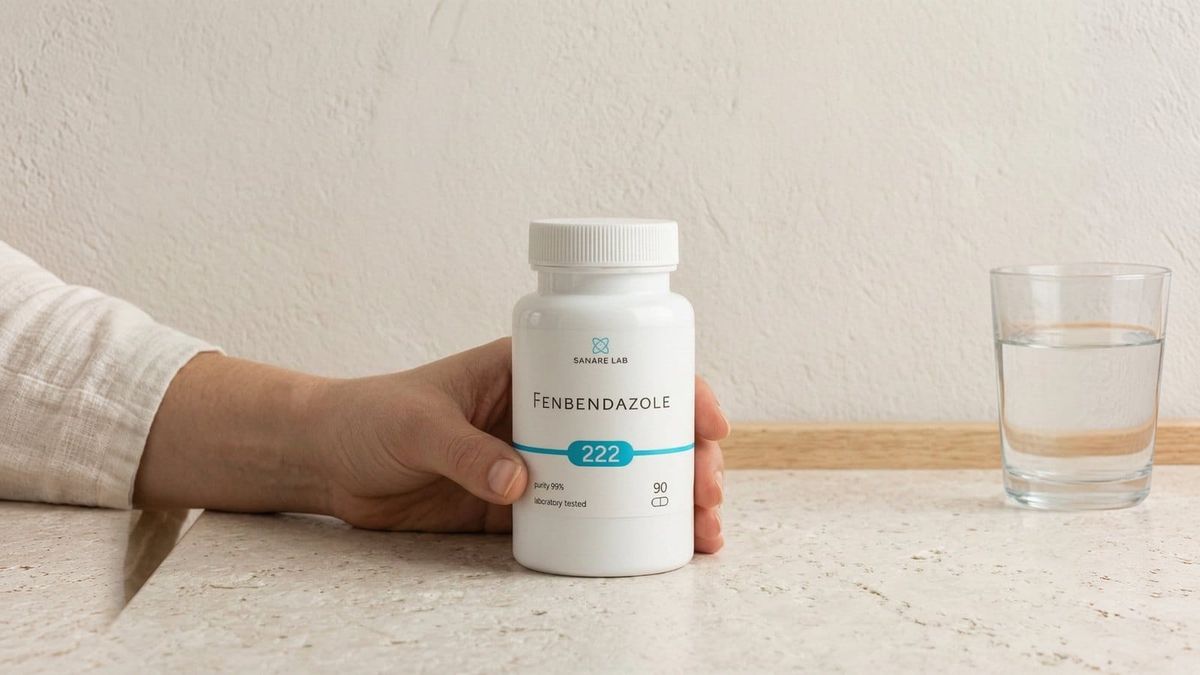
Fenbendazole 222 mg
99%+ purity, third‑party lab tested.

Pharmaceutical grade
Fenbendazole 444 mg
Double strength, 99%+ purity, lab tested.

Daily adjunct
Curcumin 360 mg
95% curcuminoids with black pepper extract.
Prices checked September 2026 and may change; the store page shows the current price.
Disclaimer: Links are informational and for convenience. This site does not provide medical advice. Always verify product quality, labeling, and consult a licensed professional for health decisions.
References
- Xu X, Liang R, Zhao A, et al. Ferroptosis Induction by Fenbendazole Combined With Photothermal Therapy Triggers Dual-Immunotherapy Against Bladder Cancer. Adv Sci (Weinh). 2026. PMID 41861111.
- Liang M, et al. Synergistic intravesical instillation for bladder cancer: CRISPR-Cas13a and fenbendazole combination therapy. J Exp Clin Cancer Res. 2024. PMID 39128990.
- Dogra N, Kumar A, Mukhopadhyay T. Fenbendazole acts as a moderate microtubule destabilizing agent and causes cancer cell death by modulating multiple cellular pathways. Sci Rep. 2018. PMID 30093705.
Medical Disclaimer
This article is for educational and informational purposes only. It is not intended to be a substitute for professional medical advice, diagnosis, or treatment. Always seek the advice of your physician or other qualified health provider with any questions you may have regarding a medical condition. Never disregard professional medical advice or delay in seeking it because of something you have read on this website.
Sanare Lab
Science-based health education team reviewing published research on repurposed drugs, integrative oncology, and evidence-based protocols.